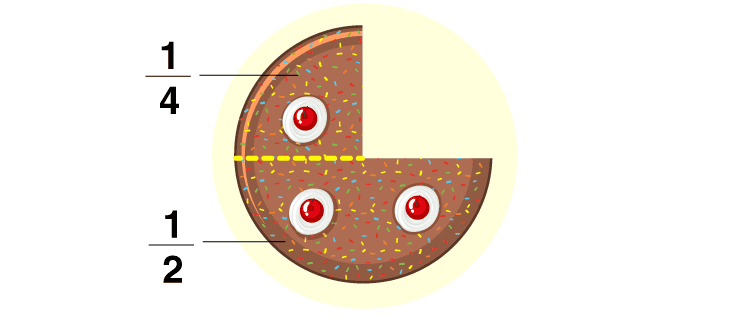
The fractions include two parts, numerator and denominator.
- Numerator: It is the upper part of the fraction, that represents the sections of the fraction
- Denominator: It is the lower or bottom part that represents the total parts in which the fraction is divided.
Example: If 3/4 is a fraction, then 3 is the numerator and 4 is the denominator.
Properties of Fractions
Similar to real numbers and whole numbers, a fractional number also holds some of the important properties. They are:
- Commutative and associative properties hold true for fractional addition and multiplication
- The identity element of fractional addition is 0, and fractional multiplication is 1
- The multiplicative inverse of a/b is b/a, where a and b should be non zero elements
- Fractional numbers obey the distributive property of multiplication over addition
Types of Fractions
Based on the properties of numerator and denominator, fractions are sub-divided into different types. They are:
- Proper fractions
- Improper fractions
- Mixed fractions
- Like fractions
- Unlike fractions
- Equivalent fractions
Proper Fractions
The proper fractions are those where the numerator is less than the denominator. For example, 8/9 will be a proper fraction since “numerator < denominator”.
Improper Fractions
The improper fraction is a fraction where the numerator happens to be greater than the denominator. For example, 9/8 will be an improper fraction since “numerator > denominator”.
Mixed Fractions
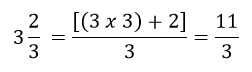
A mixed fraction is a combination of the integer part and a proper fraction. These are also called mixed numbers or mixed numerals. For example:
Like Fractions
Like fractions are those fractions, as the name suggests, that are alike or same.
For example, take ½ and 2/4; they are alike since if you simplify it mathematically, you will get the same fraction.
Unlike Fractions
Unlike fractions, are those that are dissimilar.
For example, ½ and 1/3 are unlike fractions.
Equivalent Fractions
Two fractions are equivalent to each other if after simplification either of two fractions is equal to the other one.
For example, ⅔ and 4/6 are equivalent fractions.
Since, 4/6 = (2×2)/(2×3) = 2/3
Unit Fractions
A fraction is known as a unit fraction when the numerator is equal to 1.
- One half of whole = ½
- One-third of whole = 1/3
- One-fourth of whole = ¼
- One-fifth of whole = ⅕