

Sexual Reproduction in Plants
May 17, 2024 | by Bloom Code Studio

All the flowering plants have the capacity to sexually reproduce. A flower is the reproductive organ of plants that produce gametes. The androecium is the male reproductive part which contains the stamen where sperm is produced, while the gynoecium is the female reproductive part which contains the ovary where ova are produced.
Plants mostly follow anisogamy where both allogamy and autogamy are seen. In the unisexual flower, allogamy is only seen, while in the bisexual flower both allogamy and autogamy occur.
Most of the flowers contain both the androecium and gynoecium, so produce both the male and female gametes. Such flowers are called bisexual flowers. E.g. rose, sunflower, pea, orchid, rice, etc.
The flower which has either androecium or gynoecium only is called a unisexual flower. It is seen in some plants like papaya, watermelon, maize, coconut, cucumber, pumpkin, etc.
Sexual reproduction in plants can be described in three stages; gametogenesis, pollination, and fertilization.
1. Gametogenesis in Plants
It is the process of production of gametes. The androecium is the male reproductive part of the plants. It is divided into 3 parts; stamen, filament, and anther. The anther contains two chambers called microsporangia (pollen sac) inside which pollen grains are formed. The inner lining of microsporangia is made of pollen mother cells. These pollen mother cells divided meiotically to form haploid pollens. The pollen grain divides into two cells; the smaller generative cell, and the larger vegetative cell. The generative cell develops and divides into two microgametes (male gametes), and the vegetative cell forms a pollen tube. This process of formation of microgamete is called microsporogenesis.
The gynoecium is the female reproductive part of a plant. It contains three parts; stigma, style, and ovary. Inside the ovary, there are multiple lobes where ovules are present. Cells of the ovule develop and differentiate into the diploid megaspore mother cells. It divided meiotically into 4 haploid megaspores out of which 3 degenerates leaving one megaspore. The nucleus of the megaspore then meiotically divides to form 8 haploid nuclei, out of which six migrate to opposing poles (3 in each pole). The remaining two nuclei, called the polar nuclei, fuse to form the secondary nucleus. The 6 nuclei that have migrated towards the poles will form the embryo sac, and the secondary nucleus forms the female gamete nucleus. This entire structure is called the megaspore, and the process of formation is called megasporogenesis.
2. Pollination in Plants
The male gametes are produced in the anther of a stamen. The gametes are produced in the form of pollen grains. These pollen grains need to be transferred to the stigma of the pistil in the gynoecium of the same or different flower. This process is called pollination.
Based on the flowers among which the pollen grains are transferred, pollination is of two types:
- Self-pollination; the pollination process where the pollen produced by the anther of a flower is transferred to the stigma of the same flower is called self-pollination.
- Cross-pollination, the pollination process where the pollen produced by the anther of one flower is transferred to the stigma of another flower of the same or different plant, is called cross-pollination.
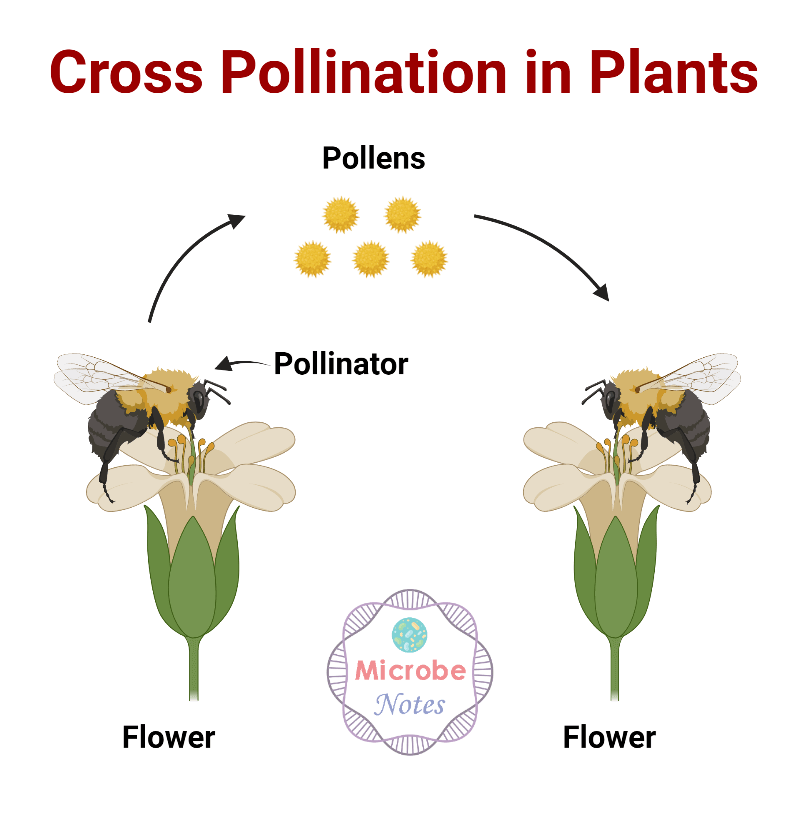
Pollination is facilitated by external agents called pollinators, like wind, insects, water, birds, animals, etc. After the pollination process, the pollens are converted to pollen tubes and transferred through the style to the ovary. At the ovary, male gametes are released from the pollen tubes and fertilize the ova.
3. Fertilization in Plants
It is the process of fusion of male gametes released from pollen grains with the ovum in the ovary of stigma to form a zygote. The zygote develops into a seed containing embryo and endosperm.
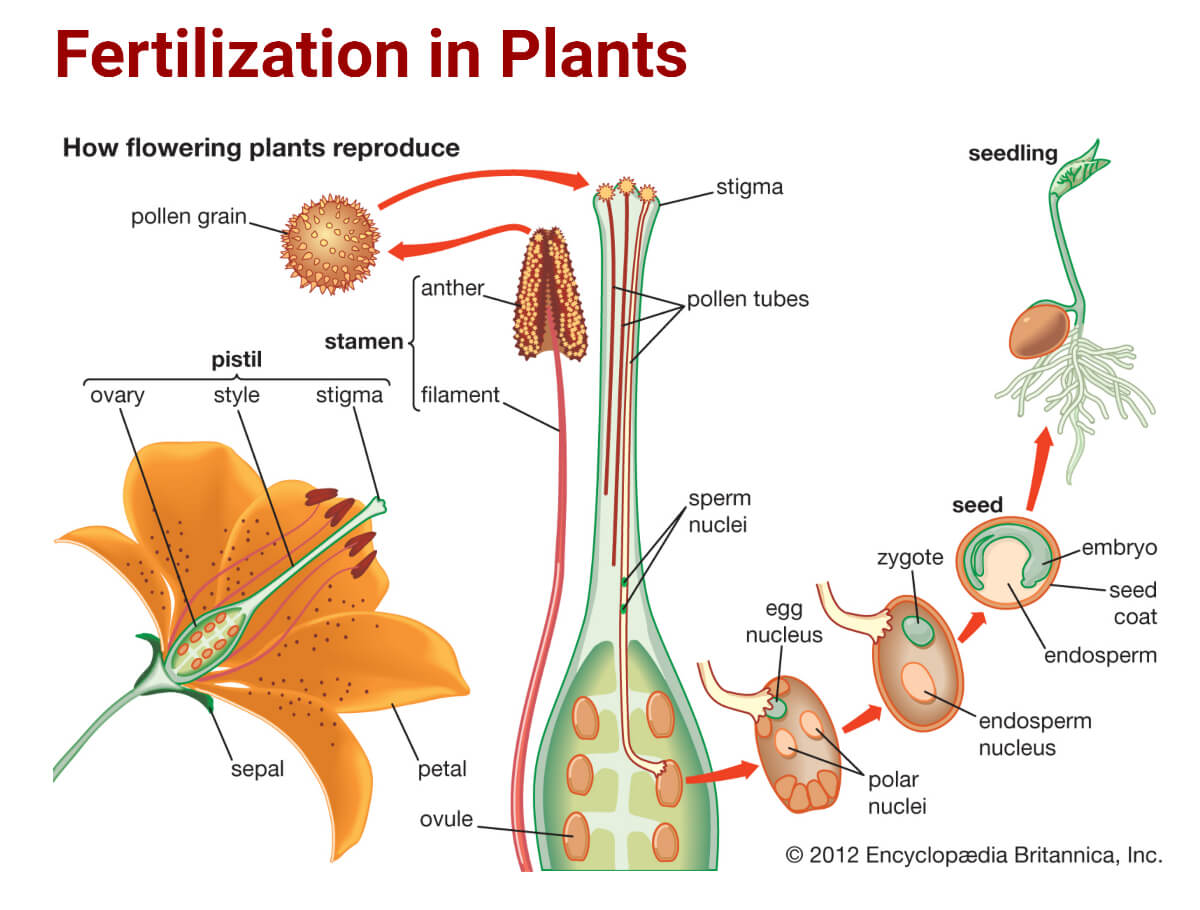
The wall of the zygote forms wall of the seed. The embryo is differentiated into the plumule, the radicle, and the cotyledon. The seed will be dispersed via different modes like insects, birds, animals, wind, water, etc. and under suitable environmental conditions, it germinates into a new baby plant.
RELATED POSTS
View all


Sexual Reproduction Advantages
May 17, 2024 | by Bloom Code Studio
Sexual Reproduction Disadvantages
May 17, 2024 | by Bloom Code Studio
Sexual Reproduction in Animals
May 17, 2024 | by Bloom Code Studio