

Phylum Porifera Characteristics
May 16, 2024 | by Bloom Code Studio

- Porifera are all aquatic, mostly marine except one family Spongillidae which lives in freshwater.
- They are sessile and sedentary and grow like plants.
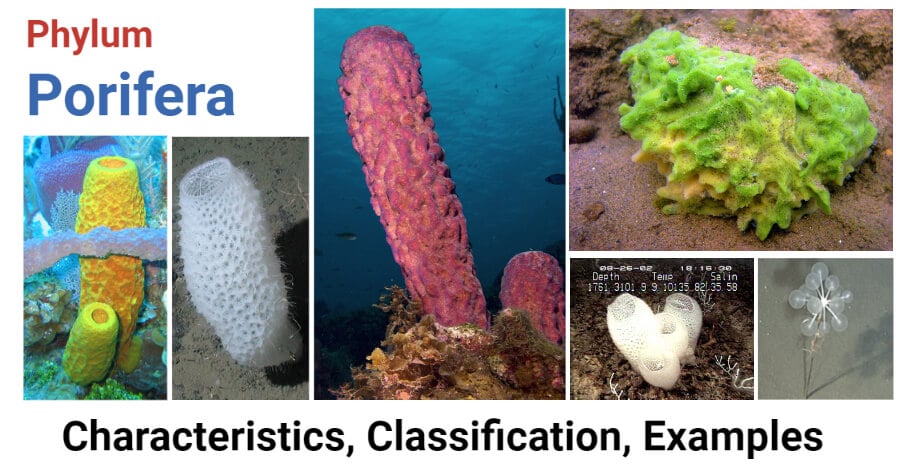
- The body shape is vase or cylinder-like, asymmetrical, or radially symmetrical.
- The body surface is perforated by numerous pores, the Ostia through which water enters the body and one or more large openings, the oscula by which the water exists.
- The multicellular organism with the cellular level of body organization. No distinct tissues or organs.
- They consist of outer ectoderm and inner endoderm with an intermediate layer of mesenchyme, therefore, diploblastic
- The interior space of the body is either hollow or permeated by numerous canals lined with choanocytes. The interior space of the sponge body is called spongocoel.
- Characteristic skeleton consisting of either fine flexible spongin fibers, siliceous spicules, or calcareous spicules.
- Mouth absent, digestion intracellular.
- Excretory and respiratory organs are absent.
- Contractile vacuoles are present in some freshwater forms.
- The nervous and sensory cells are probably not differentiated.
- The primitive nervous system of neurons arranged in a definite network of bipolar or multipolar cells in some, but is of doubtful status.
- The sponges are monoecious.
- Reproduction occurs by both sexual and asexual methods.
- Asexual reproduction occurs by buds and gemmules.
- The sponge possesses a high power of regeneration.
- Sexual reproduction occurs via ova and sperms.
- All sponges are hermaphrodite.
- Fertilization is internal but cross-fertilization can occur.
- Cleavage holoblastic.
- Development is indirect through a free-swimming ciliated larva called amphiblastula or parenchymula.
- The organization of sponges are grouped into three types which are ascon type, sycon type, and leuconoid type, due to simple and complex forms.
- Examples: Clathrina, Sycon, Grantia, Euplectella, Hyalonema, Oscarella, Plakina, Thenea, Cliona, Halichondria, Cladorhiza, Spongilla, Euspondia, etc.
RELATED POSTS
View all


Adsorption Definition
May 16, 2024 | by Bloom Code Studio
Absorption Definition
May 16, 2024 | by Bloom Code Studio
Examples of Adsorption
May 16, 2024 | by Bloom Code Studio