

Morphology/ Anatomy of Angiosperms
May 13, 2024 | by Bloom Code Studio

Angiosperms consist of different four parts flowers, leaves, stems, and roots. Flowers are the reproductive organs, while other body parts are non-sexually reproductive parts.
Generally, angiosperms are divided into two parts root system (which represents the parts of the plant which is located under the soil) and the shoot system (which represents the part of the plant above the soil).
Angiosperms Root system
- It is an underground part of the plant, a brown, non-green part. Primary rot and lateral or branching root are present in the root system.
- Root systems help in the storage, anchorage, and absorption of mineral waters from the soil and provide nutrition all over the body.
- A root that arises from the radicle of the embryo of the seed is called the primary root, and lateral branches are grown from the primary root, called secondary roots.
- The roots have unicellular root hair.
- Generally, the root tip is protected by a thin-like structure called a root cap.
- The origin of lateral roots is endogenous nature.
- The root is positively geotropic but negatively phototropic.
Generally, two types of root systems are seen in angiosperms one is the tap root, and another is the adventitious root.
1. Taproot
- Taproot arises from the radicle of the embryo (germinating seed).
- It is always underground and penetrates very deep into the soil.
- It consists of a prominent root that gives many thin branches; the primary root persists throughout the life of the plant.
- The tap root system is mainly found in dicotyledonous plants such as mangoes, mustard seeds, and banyan.
2. Adventitious root system
- Adventitious root system arises from any part of plants other than the radicle.
- It may be underground, or some are aerial and don’t penetrate the deep soil.
- Clusters of roots are present that may grow from the same point.
- The primary root is short-lived and is soon replaced by adventitious roots.
- This root system is mostly found in monocotyledonous plants such as maize, oak, trees, and horsetails. Functions of adventitious root systems are vegetative propagation and mechanical supports.
- In wheat, carrot, onion, grass, and paddy, fibrous adventitious roots were found. This type of root arises from thin, primary, or moderately branchy root growing from the stem, fibrous adventitious root system found in fern and monocotyledonous.
Angiosperms Shoot system
1. Stems
- The essential part of the plant is the stem. It is an aerial axis in nature.
- Stems bear the flowers, fruits, and leaves.
- The function of the stem is the conduction of minerals and water.
- It is connected to the root system for the continuous flow of nutrients by a transition region known as hypocotyl.
- Steams developed from the plumule of the germinating seeds.
- Generally, young stems’ color is green and becomes woody and brown when it grows into a tree.
- It provides axial stability to plants.
- The terminal bud is present at the apex of the steams.
- In angiosperms, stems are differentiated into nodes (points where the plant bears leaves) and internodes (area between the two nodes).
According to phyllotaxy, we can study the arrangements of leaves on the stems as follows:
- One leaf per node as a spiral arrangement.
- One leaves per node with a divergence of 180 degrees as the alternate arrangement.
- Two leaves per node are opposite arrangement and,
- More than two leaves per node are a whorled arrangement.
- Except for axial stability, the stems of plants undergo certain conditions that undergo modification, such as suckers, runners, climbers, tubers, tendrils, thorns, bulbils, cladode, and rhizomes. That helps in the protection, synthesis of food, vegetative propagation, etc., to keep the plant healthy and growing even with the changing condition.
2. Leaves
- Leaves of the angiosperms are usually flattened and laterally born structures. It is an important part of the plant for photosynthesis, absorbing lights, and the exchange of gases via the stomata.
- The leaf base, petiole, stipules, and lamina, also called a blade, are the main part of a leaf.
- A couple of stipules are found on each turn of the leaf base, but the lamina and the leaf base are linked through the petiole.
- The leaf grows from the node and bears a bud at the axil.
- The leaves are green due to the presence of chlorophyll (which is photosynthetic pigment) and have a tiny pore or opening called stomata.
- Venation is the terms refers to the arrangement of veins and veinlets in a leaf.
- Based on a pattern of leaf lamina, leaves can be further divided into simple and compound leaves, and different other types of classification are done based on the arrangement of leaves, venation, and shape of the leaf.
- There are some essential functions performed by leaves are storage, photosynthesis, transpiration, guttation, and defense.
- The basic structure of the leaf differs from one plant to another plant depending on its functionality and the presence or absence of petiole and stipules. The various structural form of leaves is leaf tendrils, spines, storage leaves, and insect-catching leaves.
3. Flower
- The flowers are the reproductive part of angiosperms. Micro and megaspores are arranged in flowers that may be bisexual or unisexual.
- Flowers are arranged on the floral axis is called inflorescence, which is two types one is Racemose (that lets the main axis continue to grow), and the second is Cymose (that terminates the main axis in a flow).
- They are beautiful, color full, and most of them have a sweet smell. Insects and birds are attracted to the flower due to the smell. Birds and insects play an important role as vectors for the transport of pollen grains from the anther to the stigma of different plants or the same plant. This process is called pollination.
- Pollens, stamens and carpels are main parts of flower.
- The pollen grain is produced by stamens; it is the male gamete (or sperm) that unites with the female gamete ova present in the ovary.
- Carpel is the female part consisting of stigma, style, and ovary, and the stamen is the male part consisting of anther and filament.
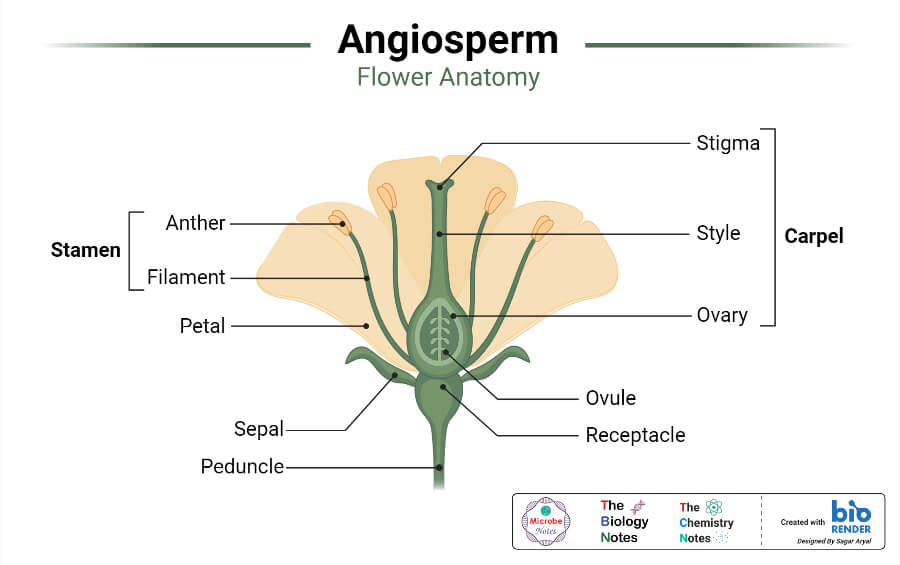
Four different whorls are present in the flowers, which are as follows:
- Calyx: it is the outermost part of the flowers.
- Corolla: corolla comprises petals.
- Androecium: it is comprises of stamens.
- Gynoecium: it is composed of one or more carpels.
- The primary function of flowers is reproduction, production of diaspores without fertilization, developing gametophytes, attracting insects and birds for pollination, and developing fruits that contain seeds.
4. Fruits
- A mature ovary develops into fruits containing seeds. The fruits produced without fertilization are known as parthenocarpic.
- Three various types of fruits are known based on the mode of development.
- Simple (developed from the monocarpellary or multicarpellary)
- Aggregate (developed from the multicarpellary) and,
- Composite (developed from the entire inflorescence rather than from a single flower example are blackberries, strawberries, etc.).
- Seeds: seeds are found inside the fruits, made up of an embryo and seed coat. Seeds are classified into two groups depending on the number of cotyledons; monocotyledonous and dicotyledonous.
RELATED POSTS
View all

Uses and Applications of Angiosperms
May 13, 2024 | by Bloom Code Studio
Evolution of Angiosperms
May 13, 2024 | by Bloom Code Studio
Angiosperms Examples
May 13, 2024 | by Bloom Code Studio