


Learn black hole facts, such as what we mean by “singularity” and “ergosphere,” and why we think black holes are real.
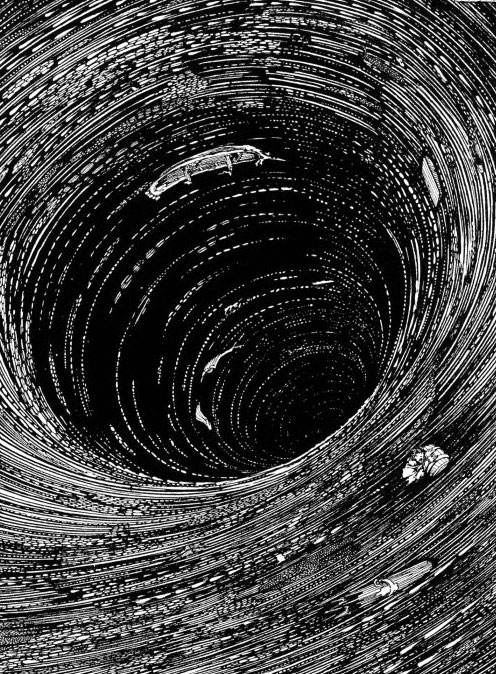
Harry Clarke, from Edgar Allan Poe’s story “Descent into the Maelstrom” (1919)
WHAT IS A BLACK HOLE?
A black hole is a pit in the fabric of spacetime. Space and time, according to Einstein’s theory of special relativity, are interchangeable parts, or dimensions, of spacetime, much as width, height, and depth are dimensions of a box. Einstein’s theory is sometimes blamed for “making everything relative,” because it says the dimensions of space and time aren’t absolutes and can change, contracting or dilating depending on your frame of reference — effects only noticeable when dealing with strong gravity or relativistic speeds. However, that accusation is misleading, because units of spacetime are absolute.
In this wacky landscape, a black hole is a cosmic pothole. Black holes are places where the density of matter grew so high that the outward pressure of the matter’s particles couldn’t withstand the inward pull of gravity. So gravity, like a master poker player, gathered all the chips together and crushed them into what’s called a singularity. We don’t really understand what happens at the singularity; we only know that there, classical physics breaks down.
A singularity and a black hole are not the same thing. The singularity hides inside a black hole, screened from view by the black hole’s event horizon. The event horizon is the so-called point of no return: the region within which nothing, not even light, can escape the black hole’s gravitational pull.
However, this all becomes far more complicated if the black hole is spinning.
THE ERGOSPHERE
A spinning black hole is more like a whirlpool than a pothole. The swirling water in this analogy is spacetime itself. It’s pulled around as the black hole rotates. This region of twisted spacetime is called the ergosphere. It is impossible to stand still in this region.
A spinning black hole has kinetic energy bound up in its spin, in the same way that a spinning top is more energetic than a top lying down. That energy can be tapped into and transferred to other things in the black hole’s environment. (The term ergosphere comes from the Greek word for “work.”) Astronomers think that a black hole powers its jets with energy from its spin.
HOW FAST DOES A BLACK HOLE SPIN?
When astronomers measure a black hole’s spin, they report the value as a fraction of the maximum allowed spin. For example, the bigger member of the black hole binary in the quasar OJ 287 has a spin, labeled a, of 0.313, or 31.3% of its max. But what does that mean?
This number is related to the black hole’s angular momentum; it’s not a fraction of the speed of light. But we can turn it into a fraction of the speed of light. S&T readers are often no strangers to math, so here you go: the rotational velocity at the event horizon of a black hole is given by
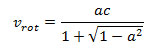
where c is the speed of light. (The derivation is a bit messy; this equation comes thanks to Scott Hughes at MIT.) So for OJ 287 and its spin of a = 0.313, the black hole is spinning at 0.16c, or 16% the speed of light.
RELATED POSTS
View all

