


Mensuration deals with the measurement of area, perimeter, surface area and volume of different types of shapes.
Let us recall the area of all two-dimensional shapes.
| Shape | Area |
| Rectangle | a × b |
| Square | a × a |
| Triangle | ½ b × h |
| Parallelogram | b × h |
| Circle | πr2 |
Mensuration Class 8 – Area of Trapezium
By constructing EC || AB, we can split the given figure (AEDCBA) into two parts (Triangle ECD right-angled at C and Rectangle AECB), Here, b = a + c = 30 m
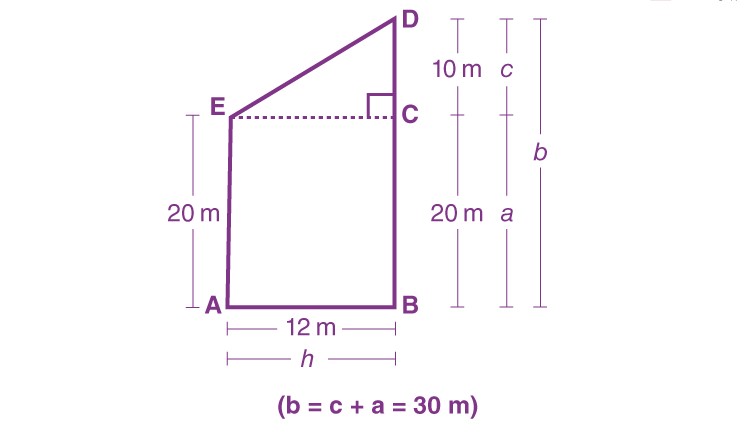
Now, Area of Triangle DCE:
1/2 × CD × EC= 1/2 × c × s
h = 1/2 ×10× 12 = 60 m2
Also, Area of rectangle AECB = AB × BC = h × a=12 × 20=240 m2
Therefore, Area of trapezium AEDB = Area of Triangle DCE + Area of rectangle AECB = 60 + 240 = 300 =300m2
Area of Trapezium = Height/2 (Sum of parallel sides) = 1/2 h(a+b)
Mensuration Class 8 – Area of General Quadrilateral
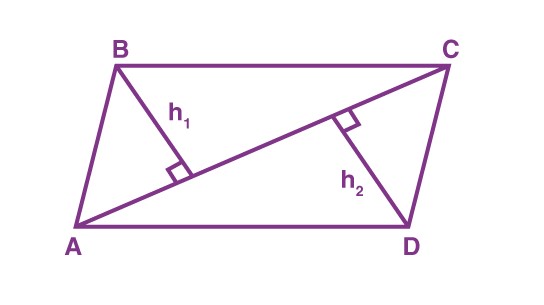
Diagonal AC divides the given quadrilateral into two triangles i.e. Triangle ABC and Triangle ADC.
Now, Area of Quadrilateral ABCD = Area of Triangle ABC + Area of Triangle ADC.
=1/2 × AC × h1 + 1/2 × AC × h2 =1/2 × d × (h1 +h2)
Where, d = The length of diagonal of a quadrilateral.
The area of other polygons (pentagon, hexagon, etc.) can be determined, by splitting them into a number of triangles and finding the respective areas.
RELATED POSTS
View all

