


Basic Arrangement of Periodic Table
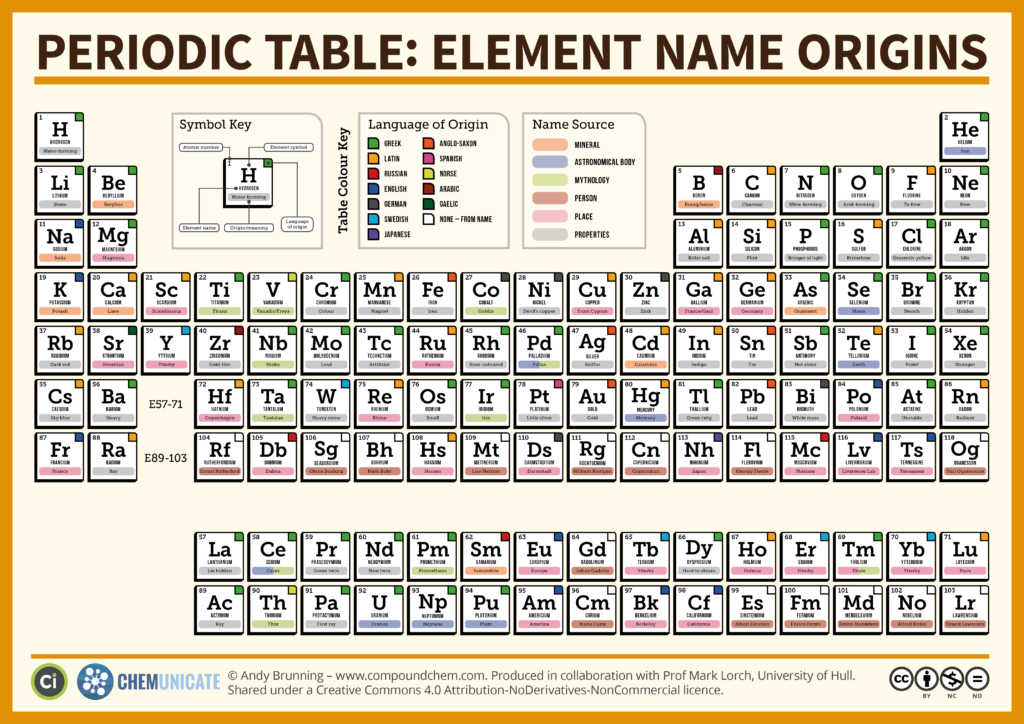
In Chapter 3, we will delve more into the initial construction and modifications of today’s periodic table. For now, you need to be aware that the periodic table has columns (known as families/groups). Horizontal rows are called periods. On the table below, the element symbols are either one or two letters. Previously, some of the newly discovered elements (see period seven on other tables) used three-letter symbols. These three-letter symbols corresponded to a Latin numbering system until the elements were given official names.
Languages of Element Names
Interestingly, different languages are used on the periodic table. Depending on your background, you might be more familiar with some elemental symbols than others. For example, Hydrogen is represented by the symbol H. This element’s name is derived from the Greek hydro, and genes which means to generate water. Other elemental symbols like copper (which has a symbol of Cu) are not so predictable. This particular element’s name originated from the Latin cuprum (from the island of Cyprus). A variety of languages are displayed on the periodic table. For example, German roots are present in the element Tungsten. The symbol for this element is W which corresponds to the German word, wolfram. For this particular class, you will find a list of required elements/symbols that need to be memorized. Please locate this document on the modle page for this course.
Meanings of Element Names
Many elements are named in honor of people. Some familiar names you might see are curium (Marie and Pierre Curie), einsteinium (Albert Einstein), and mendelevium (Dimitri Mendeleev). IUPAC (International Union of Pure and Applied Chemistry) requires these types of names to be done posthumously. In other words, the scientist who discovered the element could not name it after her/himself or anyone who is still currently living. Over the years, there have been two exceptions. The elements of seaborgium (Sg) and oganesson (Og) were named while Glen Seaborg and Yuri Oganessian were still living. Seaborgium was named in honor of an American nuclear chemist who synthesized the element plutonium. He is also credited with assisting the discovery of other elements like c, americium (element 95), curium (element 96), and fermium (element 100). His accomplishments encouraged his fellow researcher, Albert Ghiorso, to name Seaborgium in honor of him. As for element 118 (oganessian), a joint research commission of Russian and American scientists named this element for Russian physicist, Yuri Oganessian. As of 2017, Oganessian is still living and is responsible for the discovery of superheavy elements. For test 1, please research an element that has not been mentioned on this page or on your list to be memorized. By accessing this link, information about a selected element can be obtained. You will need to provide the symbol and interesting factoid for five-point question.
It is acceptable to name an element in honor of a geographical location. Some notable Earth locations would include Am (americium, American continent), Ge (germanium, Germany), Fr (francium, France), and Eu (europium, European continent). Some scientists have ventured past Earth to name their elements in honor of other places. Examples of these would include Pu (plutonium, Pluto), U (uranium, Uranus), and Np (neptunium, Neptune).
RELATED POSTS
View all

