

Asexual Reproduction Types
May 17, 2024 | by Bloom Code Studio

Based on the mode of producing offspring, asexual reproduction is classified into several types, viz.:
A. Fission
Fission simply means division. It is a mode of asexual reproduction where unicellular organisms divide into two or more individuals. It is the most primitive and simple mode of reproduction, shown by unicellular organisms only like bacteria and protozoa. Here the genetic material (nucleus) splits into two or more parts. Then the cytoplasm also divides and new daughter cells are formed; each daughter cell with one nucleus. Depending upon the number of daughter cells produced from fission, it is further classified as binary fission and multiple fission.
1. Binary Fission
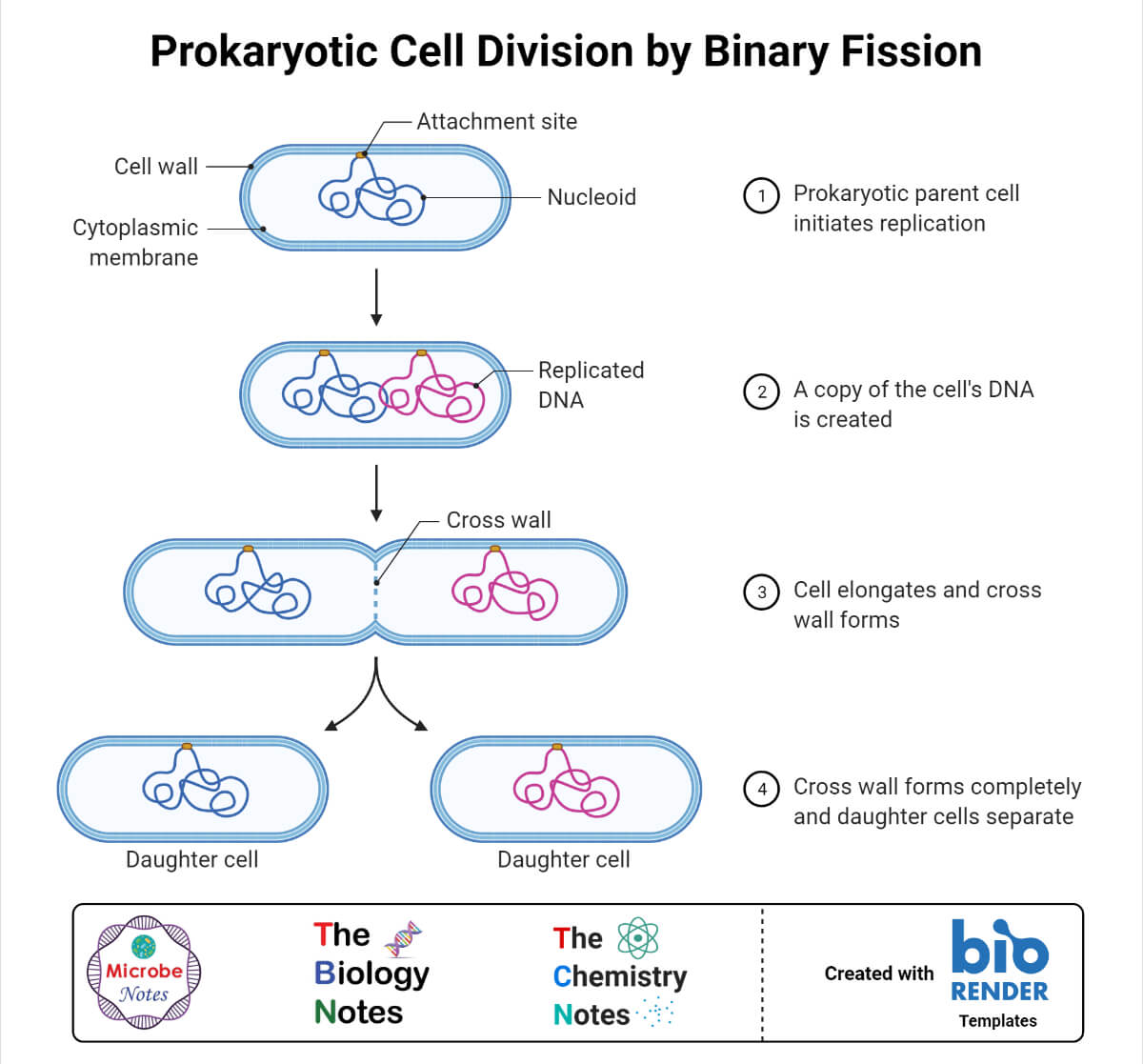
It is the process of asexual reproduction where a single individual divides into two new individuals (daughter cells). Here, first, the DNA (nucleus) is replicated and divided into two, followed by the division of cytoplasm leading to the formation of two daughter cells. It is seen in bacteria, archaebacteria, and protozoa like Amoeba, Leishmania, Plasmodium, Paramecium, etc.
It is further classified as simple binary fission, longitudinal binary fission, transverse binary fission, and oblique binary fission.
2. Multiple Fission
It is the process of asexual reproduction where a single individual divides into more than two individuals at the same time. In this process, first, the DNA (nucleus) duplicates into several copies (nuclei) (more than two), and each copy (nucleus) is surrounded by cytoplasm leading to the formation of multiple daughter cells. It is seen in some protozoa like Entamoeba, Plasmodium, etc. some Myxomycetes, and some algae (Siphonales, Acetabularia, etc.).
B. Budding
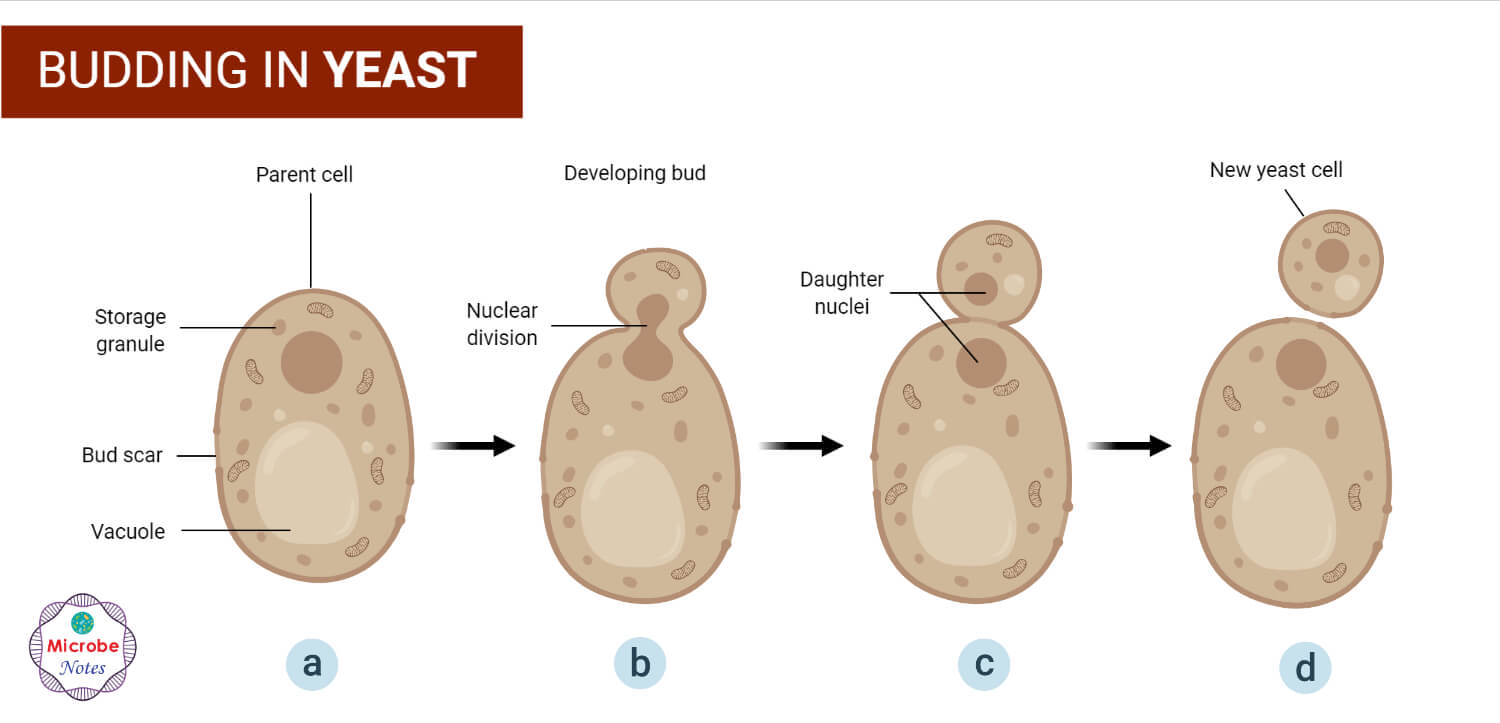
It is a type of asexual reproduction where an outgrowth on the surface of the parent’s body is specialized and separated and developed into a new individual. It is also called “blastogenesis”. In this process, a mature parent produces an outgrowth called ‘bud’. This bud will detach and grow as a new individual (daughter organism). It is seen in unicellular organisms like yeasts and fungi, certain protozoa, and some bacteria, and multicellular organisms like cnidarians (Hydra), jellyfish, flatworms, sea anemones, corals, plants, etc. Budding is further classified as internal and external budding.
1. Internal Budding (Endodyogeny)
It is the process where two daughter cells are produced within a mother cell, which is then consumed by the daughter cells before their separation. It is usually seen in parasites like Toxoplasma, Frenkelia, etc.
2. External Budding (Exodyogeny)
In this type, an external outgrowth develops on the surface of a parent organism which will detach on maturation and develop into a new individual. It is seen in yeasts, Hydra, sea anemones, etc.
C. Fragmentation
It is a type of asexual reproduction where the body of a mature organism is broken into several fragments, and each fragment will then subsequently grow into a new complete organism. It is a natural process but usually occurs as a result of some damage to a parent’s body. It is seen in some multicellular animals (like; starfish, Planaria, annelids including polychaetes and oligochaetes, turbellarians, etc.) and plants (like; Spirogyra, Liverwort, etc.).
D. Regeneration
It is a type of asexual reproduction process where a detached part of an organism develops into a fully developed individual organism. Mostly it is used for restoring damaged body parts (as in many reptiles, amphibians, crayfish, etc.), but some detached parts can grow into a complete individual like in Echinoderms, Hydra, flatworms, etc.).
E. Vegetative Propagation
It is a type of asexual reproduction shown by plants where a fragment of a plant grows into a new complete plant. The specialized reproductive part of the plant which grows into a new plant is called the vegetative propagule. It includes all the parts of the plant except seeds, fruits, and flowers. It usually occurs via stems, leaves, branches, tuber, roots, etc. Almost all the plants have the capacity to reproduce by the vegetative propagation method, and plants that can’t produce healthy seeds follow this method as their sole mode of reproduction. Plants like bananas, bamboo, sugarcane, strawberry, rose, tulip, potato, etc. are grown by this method.
F. Sporogenesis
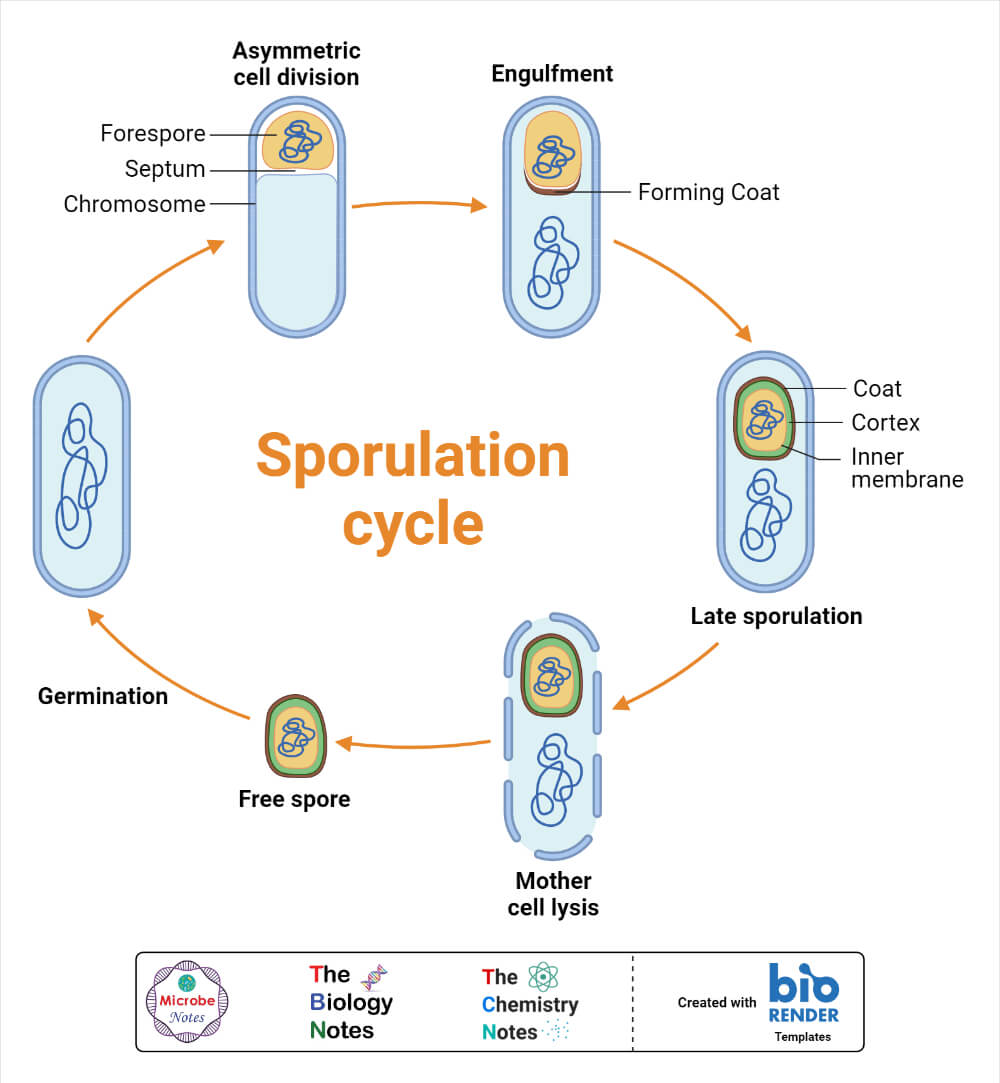
It is a type of asexual reproduction where haploid spores are produced and developed into new individuals (offspring). It is also called “monogenesis”. Spores are reproductive cells containing haploid chromosomes which can grow into a mature individual without fertilization. It is seen in many plants, algae, fungi, protozoa, and bacteria. It usually occurs in unfavorable environmental conditions, but in some plants, algae, and fungi, it is a part of their regular lifecycle.
G. Gemmulation
It is a type of asexual reproduction where a new individual is developed from a gemmule. A gemmule is an asexually produced internal cellular mass coated with tough dormant embryonic cells. It is produced in Porifera, freshwater sponges like Spongilla, and marine sponges like sea sponges, Ficulina ficus, etc. Vegetative totipotent cells called archaeocytes modify and develops into gemmules. These gemmules release out when the sponge body dies, and develop into a new individual when subjected to suitable environmental conditions.
H. Agamogenesis
It is a type of asexual reproduction where offspring is developed from a female gamete without the involvement of male gametes. In this type, the development of an unfertilized egg occurs leading to the formation of a new individual. It literally means “reproduction without fertilization”, and involves two types; parthenogenesis, and apomixis.
1. Parthenogenesis
It is a type of agamogenesis where an ovum, as a normal reproduction process, develops into an embryo and a mature individual. It is also called “virgin birth”.
It is reported in over 2000 species, mainly in invertebrates (e.g., some bees, wasps, rotifers, few ant species, aphids, water fleas, etc.), and few vertebrates (turkeys, few shark species, some amphibians like frogs and salamanders, some reptiles like rock lizards, Komodo dragons, whiptails, pythons, boas, rattlesnakes, filesnakes, etc.). In plants, it is a part of the apomixis process.
It can be either obligate or facultative parthenogenesis. Some salamanders, geckos, aphids, etc., follow parthenogenesis as the only mode of reproduction. While, parthenogenesis in sharks snakes, Komodo dragons, bees, etc. are facultative types.
Based on the type of cell division involved during the process, parthenogenesis is of two types;
Apomictic parthenogenesis; here, egg cells are produced by mitotic division and develop directly into a diploid embryo. This leads to the production of offspring which are full clones of the mother. It is seen in aphids and plants. In plants, it is a component of apomixis.
Automictic parthenogenesis; here, egg cells undergo meiotic division before developing into a zygote. This leads to the formation of haploid individuals, but in some, the offspring are reestablished as diploid in several ways. Usually, the egg cell fuses with polar bodies to restore their chromosome number. This causes the production of offspring which are half clones of the mother. It is seen in ants, bees, wasps, amphibians, reptiles, etc.
2. Apomixis
It is a type of agamogenesis occurring in plants, where a sporophyte is formed without fertilization. It is seen in plants like hawthorn, blackberries, ferns, rose, meadow grass, dandelions, etc. It is also seen in normally sexually reproducing plants when there is no male plant nearby for pollination.
RELATED POSTS
View all


Asexual Reproduction Disadvantages
May 17, 2024 | by Bloom Code Studio
Asexual Reproduction Advantages
May 17, 2024 | by Bloom Code Studio
Asexual Reproduction in Animals
May 17, 2024 | by Bloom Code Studio