

Sexual Reproduction Types
May 17, 2024 | by Bloom Code Studio

Broadly, sexual reproduction can be classified into two types; conjugation and syngamy.
1. Conjugation
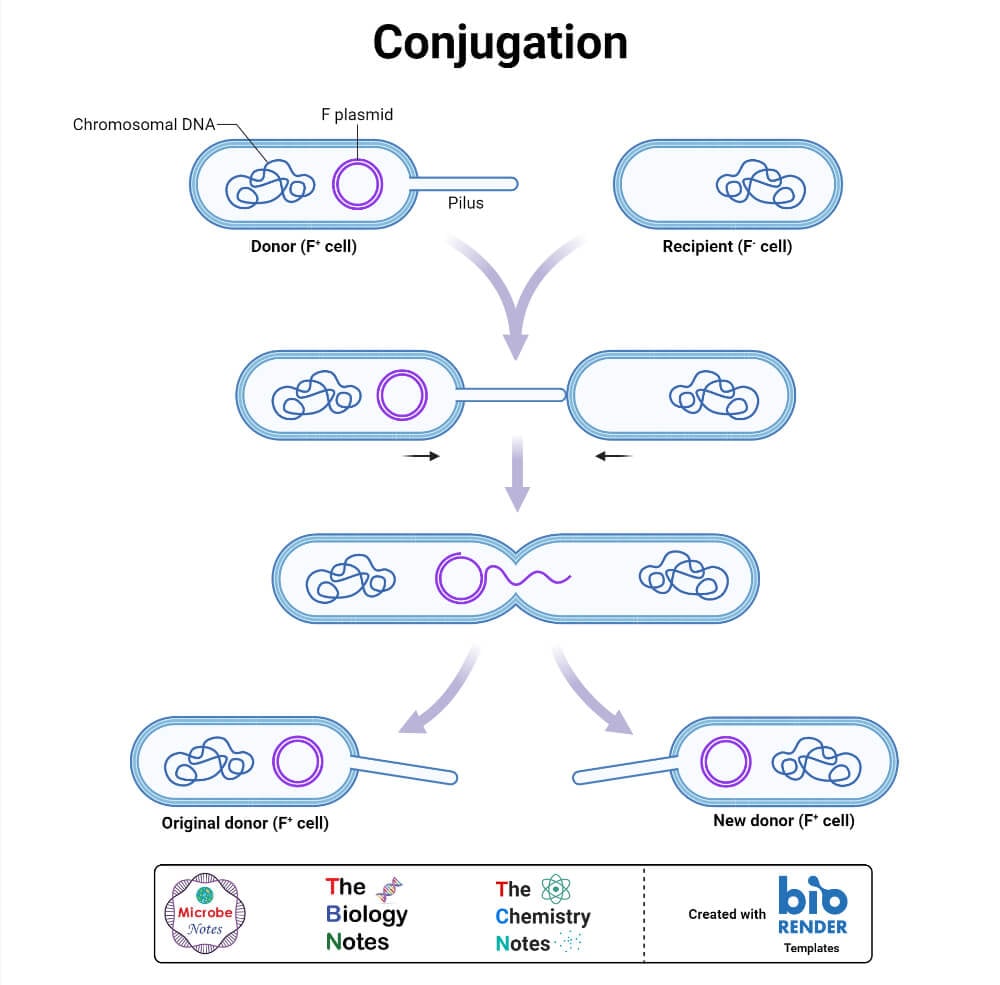
It is a type of sexual reproduction process where two individuals temporarily fuse and exchange their genetic materials through the pronuclei. It is seen in certain protozoa, algae, fungi, and bacteria. In the process, they either mutually exchange their genetic materials or completely transfer the genetic material of one to the other, or they both fuse together to form a zygote.
Instead of differentiating as male and female, the organisms are classified as mating types. They are differentiated as + and – mating types (mt (+) and mt (-).
2. Syngamy
It is the process of complete and permanent fusion of haploid male and female gametes to form a diploid zygote. It is also known as amphigony. Simply, sexual reproduction is understood as syngamy. It occurs in multicellular organisms.
Based on the number of parents involved (or the source of gametes), syngamy is of two types:
a. Exogamy (Cross-fertilization or Allogamy)
It is a biparental system where two different parents of opposite gender are involved in the process of sexual reproduction. The male parent (father) produces sperm, while the female parent (mother) produces the ovum. The two gametes produced by different individuals fuse in the fertilization process. Hence, the fertilization process is called cross-fertilization.
It is the most common type of sexual reproduction and is seen in mammals, birds, amphibians, reptiles, plants, etc. The individual involved in the process is called dioecious individuals.
The gametes are transferred during copulation or pollination in the internal fertilization process, and by water in the external fertilization process.
In plants, it is called allogamy. Allogamy is defined as the fertilization of the ovum produced by one individual with sperm produced by the next individual. In plants, the fusion of sperm and ovum produced by a separate flower on a separate plant is called allogamy.
b. Endogamy (Self-fertilization or Autogamy)
It is a type of syngamy where male and female gametes are produced by a single individual fuse to form a zygote. Such individuals are called monoecious or hermaphrodite, and the reproduction process is also called hermaphroditism. Hence, the fertilization process is called self-fertilization.
It is seen in a few lower invertebrates and some plants, such as earthworms, tapeworms, slugs, etc., and most of the flowering plants.
In plants, it is called autogamy. Autogamy is the self-fertilization process where the sperm and ovum produced in the same flower fuse together.
Based on the structure of gametes involved, syngamy is of two types:
a. Isogamy
It is a type of syngamy where the fusing gametes are morphologically similar to each other. The male and female gametes are morphologically identical and are called the isogametes. However, those isogametes can be differentiated based on their physiology. This makes organisms difficult to classify as male and female, so instead they are classified into two mating types; mt (+) and mt (-).
This form of syngamy is mainly seen in all unicellular eukaryotes, a few fungi, and algae; such as Spirogyra, Chlamydomonas, baker’s yeast, etc.
b. Anisogamy
It is a type of syngamy where the fusing of male and female gametes are of different shapes and sizes. These gametes can be morphologically differentiated. This leads to sexual dimorphism, and hence the parents are classified as male and female. It is seen in mammals, amphibians, reptiles, plants, birds, fungi, etc.
Male gametes are smaller and called microgametes or sperms. Female gametes are larger and called macrogametes or ova (eggs).
The sperm and ovum may be motile or non-motile. In most of the higher animals, an ovum is large non-motile while the sperm is small and motile. The fusion of such a non-motile ovum with a small motile is called oogamy. Mammals, birds, fishes, plants, etc., show oogamy.
There are other special modes of sexual reproduction, like:
- Hologamy; where the whole individual act as a gamete and fuses together. E.g. in Chlamydomonas, Rhizopoda, etc.
- Macrogamy; the fusion of two macrogametes. E.g. in Heliozoa
- Microgamy; the fusion of two microgametes. E.g. in Arcella and foraminers protozoa.
- Paedogamy; the fusion of two immature individuals acting as gametes that are produced by a single parent. E.g., in Actinosphaerium
- Cytogamy; the fusion of cytoplasm instead of nucleus. E.g., in Paramecium
- Automixis; autogamy where gametes produced by the division of a single nucleus fuse together.
- Neotony; production and fusion of gametes in the larval stage. For E.g. in axolotl larva
RELATED POSTS
View all


What is Sexual Reproduction?
May 17, 2024 | by Bloom Code Studio
Sexual Reproduction Disadvantages
May 17, 2024 | by Bloom Code Studio
Sexual Reproduction Advantages
May 17, 2024 | by Bloom Code Studio