

Nitrogen Cycle- Definition, Steps, Process, Significance
May 17, 2024 | by Bloom Code Studio

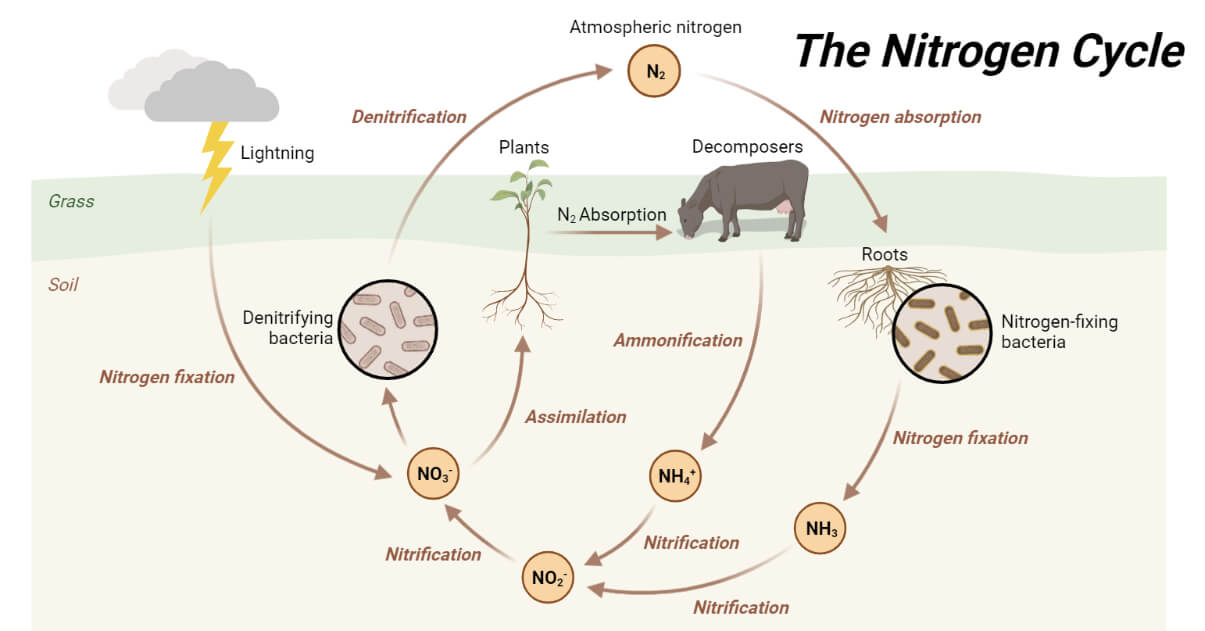
The movement of nitrogen between the atmosphere, biosphere, and geosphere in different forms is called the nitrogen cycle and is one of the major biogeochemical cycles.
- It may also be considered as the movement of nitrogen through the food chain from simple inorganic compounds, mainly ammonia, to complex organic compounds.
- This complex cycle involves bacteria, plants, and animals.
- All organisms can convert ammonia (NH3) to organic nitrogen compounds that are compounds containing C–N bonds. However, only a few microorganisms can synthesize ammonia from nitrogen gas (N2).
- Although N2 gas makes up about 80% of the earth’s atmosphere, it is a chemically unreactive compound and thus needs to be changed in order to be utilized by living beings.
- Within the biosphere, there is a balance between total inorganic and total organic forms of nitrogen.
- The conversion of organic to inorganic nitrogen comes about through catabolism, de-nitrification, and decay.
RELATED POSTS
View all


Significance of Nitrogen Cycle
May 17, 2024 | by Bloom Code Studio
Steps of Nitrogen Cycle
May 17, 2024 | by Bloom Code Studio
Nitrogen Cycle Key Terms
May 17, 2024 | by Bloom Code Studio