

Structure of seed
May 13, 2024 | by Bloom Code Studio

Structure of seed
Seeds generally consist of 3 parts: Cotyledons or embryonic leaves, the embryo from which growth commences, and the outer protective covering called the seed coat. However, the structure of seeds and their parts differ in dicot and monocot.
Structure of monocotyledonous seed
- Seed coat: The seed coat is membranous and attached to the fruit wall.
- Endosperm: Endosperm is a bulky storage organ that nourishes the growing embryo. Monocots are generally endospermic with few exceptions, like an orchid.
- Aleuron layer: It is the proteinous layer in between the outer membrane of endosperm and embryo that secretes the enzyme for the degradation of reserve food.
- Embryo: The embryo is a small fleshy body present in the groove at the end of the endosperm. The embryo is diploid. It consists of the following parts:
- Scutellum: This is the single large, shield-shaped cotyledon that nourishes the growing embryo
- Embryonal axis: They are radicle and plumule formed at two ends of the seed. The radicle grows downward and gives rise to the root of a new seedling, while the plumule grows upward and gives rise to a shoot or stem.
- Coleoptile and coleorhiza: Radicle and plumule are enclosed in a sheath called coleoptile and coleorhiza, respectively.
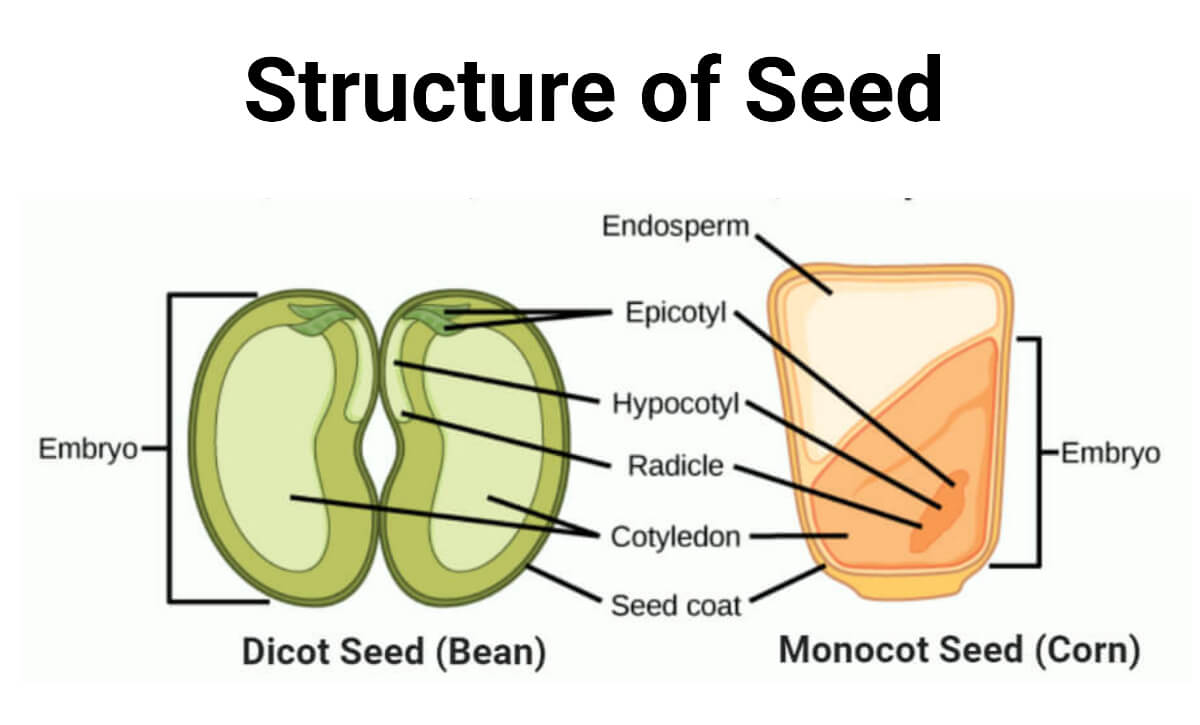
Structure of dicotyledonous seed
- Seed coat
It is developed from the integument of the ovule and has the following parts.
- Testa: It is the outer thick layer that performs a protective function.
- Tegman: It is an inner thin membranous layer that protects the inner layer of the seed.
- Hilum: It is the point on the seed coat from which the seed is attached to the endocarp of the fruit. It is equivalent to the naval of humans.
- Micropyle: It is the small round pore above the hilum for the entry of pollen tube, water, and oxygen into the embryo.
- Raphe: It is the ridge portion in the groove that remains fused with testa.
- Embryo
- Cotyledon: They are the fleshy structure present in the embryonal axis and provide nutrition for developing embryos. Dicot has two cotyledons.
- Embryonal axis: It is the miniature plant present in between the two cotyledons and consists of plumule and radicle, which later developed into shoot and root, respectively. The portion between cotyledon and radical is called hypocotyl, whereas the point between cotyledon and plumule is called epicotyl.
RELATED POSTS
View all


Seed- Definition, Types, Structure, Development, Dispersal, Uses
May 13, 2024 | by Bloom Code Studio
Seed size and shape
May 13, 2024 | by Bloom Code Studio
Seed Development
May 13, 2024 | by Bloom Code Studio