

Natural Selection- Definition, Theory, Types, Examples
May 13, 2024 | by Bloom Code Studio

Natural selection is the process whereby organisms better adapted to their environment tend to survive, pass on the genes, and produce more offspring.
It is a mechanism of evolution that causes species to change and diverge over time.
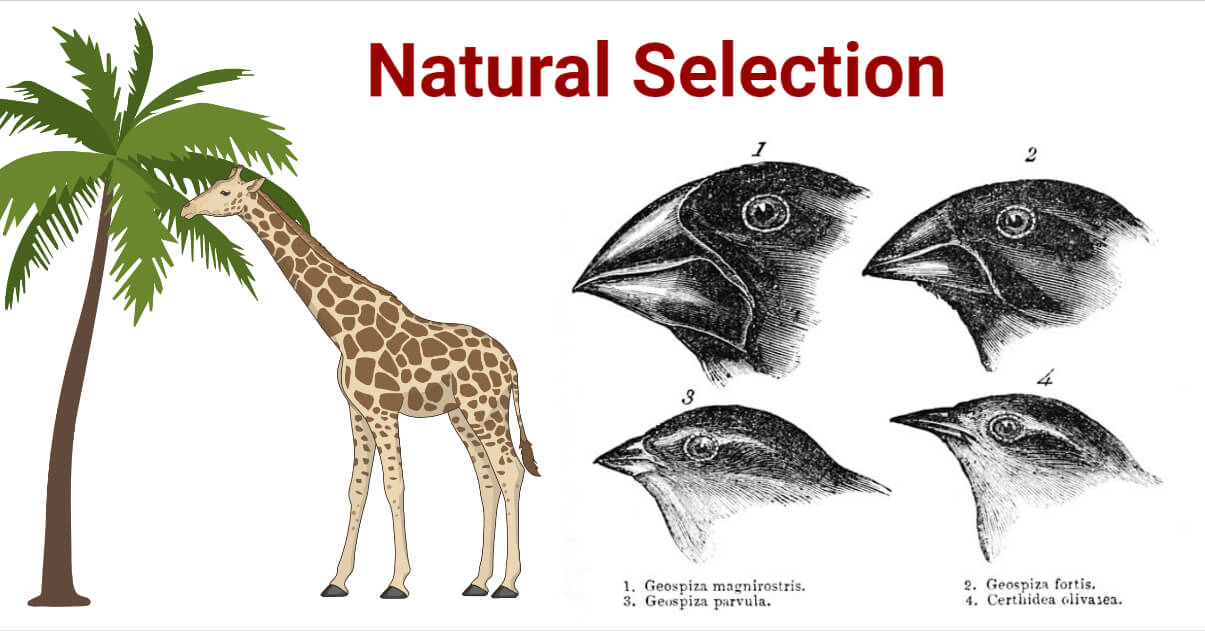
More than a century ago, in 1958, Charles Darwin (1809-1882) and Alfred Russel Wallace (1823-1913) combinedly credited the theory of evolution by natural selection and published the book “Origin of species”.
In 1859, Darwin separately published the book called “On the origin of species by means of natural selection”.
After the death of Darwin, Neo-Darwinism theory was developed based on genetic character when the gene was discovered in 1901 by American scientists Margon, Shutton, etc.
Facts that influenced Darwin’s thought or Development of the theory of natural selection
- In 1831, Darwin was the naturalist on the Voyage when he was just 22 years old. As a naturalist, he observed, collected, and analyzed specimens of plants, animals, rocks, and fossils. He spent more than three years exploring nature on the island and distant continents.
- Darwin made many observations during the long Voyage, which helped him develop the theory of evolution.
- Darwin follows the idea of Lamarck and assumes that species can change over time. Fossils he found helped conveniently follow Lamarck’s theory.
- From Charles Lyell’s book “Principles of Geology”, Darwin concluded that there had been enough time for evolution to cause the great diversity of life because he saw the earth and its life were very old.
- In late 1830, Darwin attended a meeting of animal breeders and intently read their publications. He was aware that humans could bread animals and plants to have valuable traits by selecting plants or animals which are allowed to reproduce over time to time. They could change an organism’s traits. He called this type of change variation in an organism; artificial selection.
- Darwin wondered how artificial selection could be carried out in nature, he found the solution in Thomas Robert Malthus’s book, and he knew that the population could grow faster than their resources, which eventually caused a struggle for existence.
- The term fitness was coined by Darwin and referred to an organism’s relative ability to survive and produce offspring. Variation occurs naturally, So he called this type of selection natural selection.
- Darwin spent several years thinking about the work of Lamarck, Lyell, and Malthus, what he knew about artificial selection and observation, and the results he had made his Voyage. Collecting all ideas, and all together, helped formulate his theory.
- Wallace also traveled to different Places to study nature, and he also developed the same theory of evolution as Darwin. Wallace sent a paper he had written explaining his evolutionary theory to Darwin. Wallace’s idea helped to confirm Darwin’s theory.
- At the time of controversy about the theory of natural selection, Wallace was in Indonesia, and he could not champion Darwin’s defense by adding his point of view. Thus, the theory is called the Darwinian rather than the Darwin-Wallace theory of evolution.
RELATED POSTS
View all


Types of natural selection
May 13, 2024 | by Bloom Code Studio
Example of natural selection
May 13, 2024 | by Bloom Code Studio
Darwinian theory of natural selection
May 13, 2024 | by Bloom Code Studio