

Animal Embryo
May 13, 2024 | by Bloom Code Studio

Fertilization takes place in the fallopian tube (in the ampulla region) of the female reproductive system. Before reaching the uterus, the embryo undergoes a series of divisions that help in its growth and development. Based on the location of the development of the embryo, embryogenesis can be categorized into two types:
- Viviparity: It is the type in which the fetus grows in the mother’s uterus. The animals that show viviparity are called viviparous. It results in the birth of young ones directly from the mother. For eg. In the case of humans, dogs, etc.
- Oviparity: It is the type in which the fetus grows outside the mother’s uterus into the eggs. The organisms that show oviparity are called oviparous. It results in the birth of young ones from the eggs expelled out from the mother. For eg. in the case of the chicken, ducks, etc.
The general embryogenesis process in mostly viviparous animals occurs in the following way:
- The fertilized cell or zygote in the fallopian tube further divides into two cells, followed by four, and eventually to 16-celled stages. This results in the formation of a ball-like or mulberry-shaped structure. This ball contains many cells inside it. This ball-shaped structure is called the morula.
- The morula further divides to form another structure called the blastula. In the blastula stage, the cells are arranged in such a way that they form a hollow mass. In fact, the cells align themselves to the ends and leave a cavity within, which gets filled with fluid.
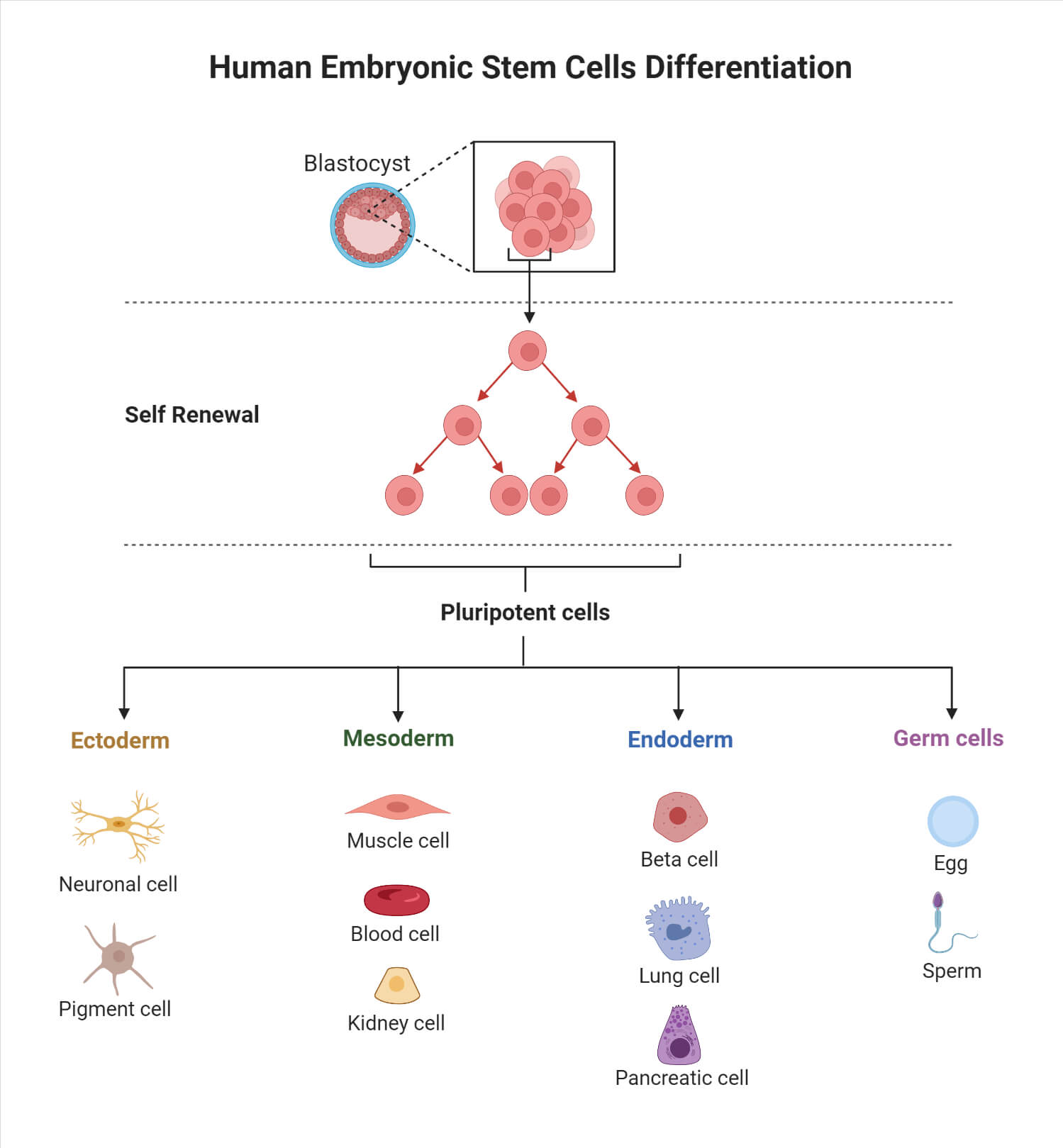
- The next stage of development after that will be the blastocyst. In this stage, the embryo will have cells that have differentiated and will even differentiate further. The differentiation process is that which makes it possible for a single cell to develop into an embryo and then into a complex organism. Differentiation is a process in which a cell gets differentiated from the other cells around it, and we get a whole new type of cell after multiple successive divisions.
- The Blastocyst stage is a mass containing differentiated cells. As it grows further, the body of the embryo begins to develop.
- The next stage is the implantation stage. As the blastocyst growing into an embryo requires an ample amount of nutrition, it needs to get attached to the walls of the uterus. This process of getting attached to the walls of the uterus is called the implantation process. This process is aimed at deriving nutrition from the mother, removing wastes, and exchanging gases. This is served through a barrier called the placenta.
- After that, the embryo starts to grow further when the organs of the baby’s body start to develop is called the fetal stage. The embryo can then be called the fetus.
RELATED POSTS
View all


Plant Embryo
May 13, 2024 | by Bloom Code Studio
Embryo- Definition, Plant, and Animal Embryo with Process
May 13, 2024 | by Bloom Code Studio