

Founder Effect: Definition, Examples, Significances
May 13, 2024 | by Bloom Code Studio

Populations change over time and this change is important for maintaining genetic diversity which is essential for the adaptability and survival of a species over generations. There are several mechanisms driving the evolutionary process. One such random evolutionary process is genetic drift, which refers to the random change in the gene pool in a population over time.
The founder effect is a specific case of genetic drift. It occurs when a small group of individuals becomes isolated or separated from a larger population to form a new, isolated population.
The founder effect leads to lower genetic diversity in the new population compared to the species as a whole. This phenomenon can result from natural disasters, such as volcanic activity or sudden flooding, creating new environments for small groups.
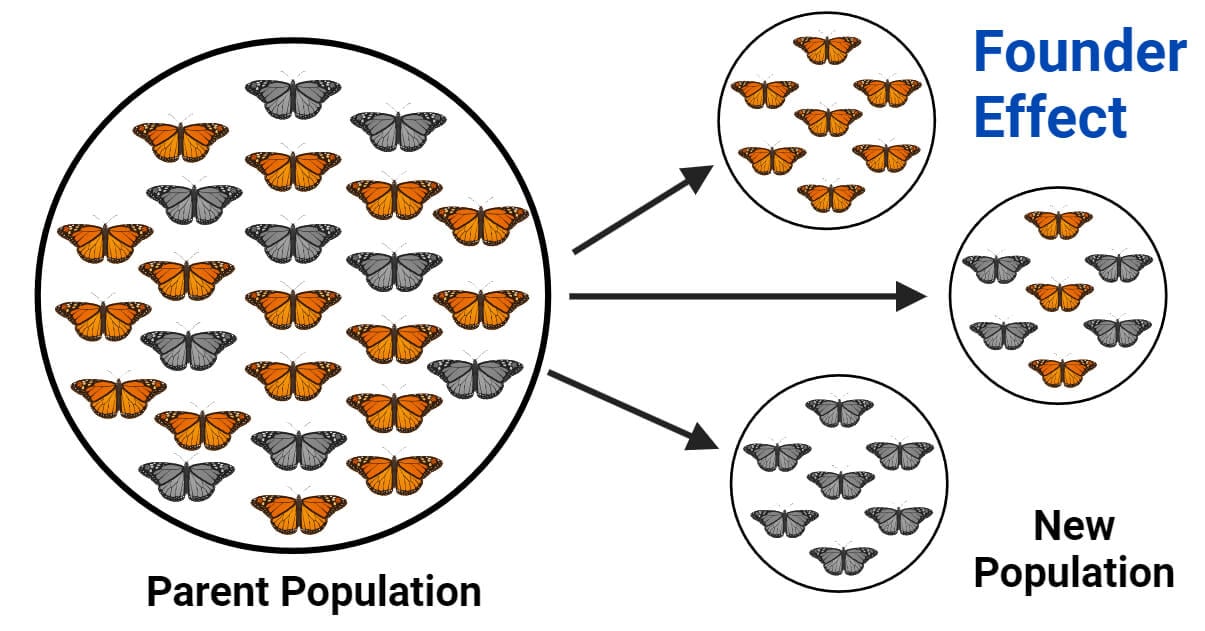
The concept of establishing a population from a small group of founders, leading to significant genetic changes and evolutionary differentiation, was initially introduced by Ernst Mayr in his genetic revolution model. In this model, the founder event plays an important role in lowering levels of heterozygosity.
Humans have experienced the founder effect throughout history as different colonies formed, with traits carried by the founders becoming more common in those populations. When a small group of humans inhabited a new land, they mated with one another, and as the population grew, the traits they carried with them became more and more common in their population than they were in the human species as a whole.
RELATED POSTS
View all


Limitations of Founder Effect
May 13, 2024 | by Bloom Code Studio
What is Founder Effect?
May 13, 2024 | by Bloom Code Studio
What is Genetic Drift?
May 13, 2024 | by Bloom Code Studio