


There are molecules and ions for which drawing a single Lewis structure is not possible. For example, we can write two structures of O3.
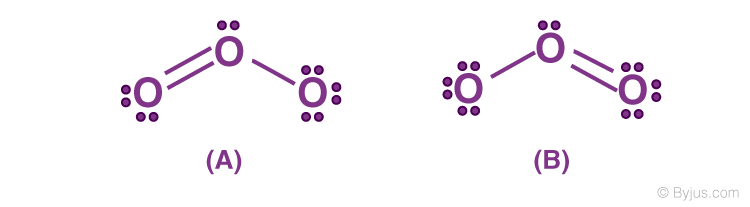
In (A), the oxygen-oxygen bond on the left is a double bond, and the oxygen-oxygen bond on the right is a single bond. In B, the situation is just the opposite. The experiment shows, however, that the two bonds are identical.
Therefore, neither structure A nor B can be correct. One of the bonding pairs in ozone is spread over the region of all three atoms rather than localised on a particular oxygen-oxygen bond. This delocalised bonding is a type of chemical bonding in which bonding pair of electrons are spread over a number of atoms rather than localised between two.

Structures (A) and (B) are called resonating or canonical structures, and (C) is the resonance hybrid. This phenomenon is called resonance, a situation in which more than one canonical structure can be written for a species. The chemical activity of an atom is determined by the number of electrons in its valence shell. With the help of the concept of chemical bonding, one can define the structure of a compound, which is used in many industries for manufacturing products in which the true structure cannot be written at all.
Here are some other examples.
- CO32– ion
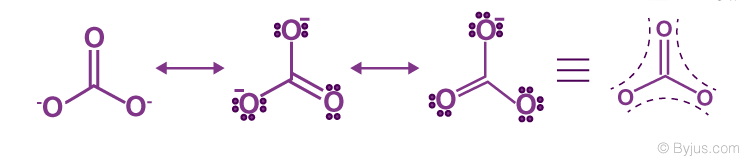
- Carbon-oxygen bond lengths in carboxylate ions are equal due to resonance.

- Benzene

- Vinyl chloride

The difference in the energies of the canonical forms and resonance hybrid is called resonance stabilisation energy.
RELATED POSTS
View all

