


Learning Objective
- Define the roles of the shoot apical meristem, leaf primordia, intercalary meristems, and axillary buds in shoot development.
- Explain the mechanism of the ABCDE model of floral development.
Some plant parts, such as stems and roots, continue to grow throughout a plant’s life: a phenomenon called indeterminate growth. Other plant parts, such as leaves and flowers, exhibit determinate growth, which ceases when a plant part reaches a particular size.
Stem and Leaf Development
In comparison to roots, in which cell division, elongation, and maturation occur in distinct regions (see Internal Root Structure), growth in stems occurs in several regions. Rapid cell division occurs at the shoot apical meristem of the shoot tip. Some of the cells produced from these divisions give rise to leaf primordia, which ultimately develop into leaves. Division, elongation, and cell differentiation (maturation) also occurs at the intercalary meristems of internodes, the stem segments between nodes, the points where leaves attach. As a result, multiple internodes can lengthen simultaneously. Under certain circumstances, the axillary buds at each node can become active and produce axillary shoots, which branch from the main stem.
Flower Development
Changes in gene expression can cause a shoot apical meristem to develop into a floral meristem, which leads to flowering. The ABCDE model (ABC model) of floral development directs the formation of each of the four whorls of a complete flower. From outside to inside, these whorls are the calyx (sepals), corolla (petals), androecium (stamens), and gynoecium (carpels). (See Angiosperms for more details; Figure .) Each unit of these whorls (sepal, petal, etc.) developmentally and evolutionarily originated from the leaf.
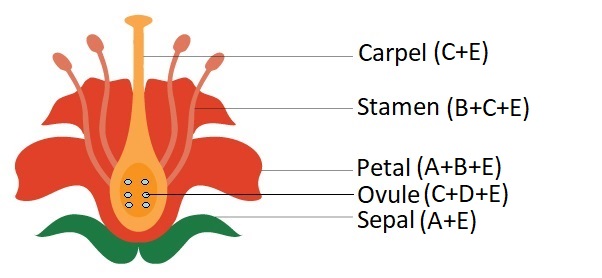
The ABCDE model refers to five groups of homeotic genes, each represented by one letter. Homeotic genes are those that control the development and organization of body parts (body plan). Each of the five groups of genes that encode the transcription factors (proteins required for gene expression), which turn on the genes for development of each whorl. Genetic analysis of mutants especially those found in the Arabidopsis thaliana and in the snapdragon (Antirrhinum) support the ABCDE model of flowering. Each group of genes has a distinct role as follows (Figure ):
- A genes are needed for sepal and petal development
- B genes are needed for petal and stamen development.
- C gene are needed for stamen and carpel (including ovules) development.
- D genes are need for ovule development (part of the carpels).
- E genes are needed to produce any of the floral whorls.
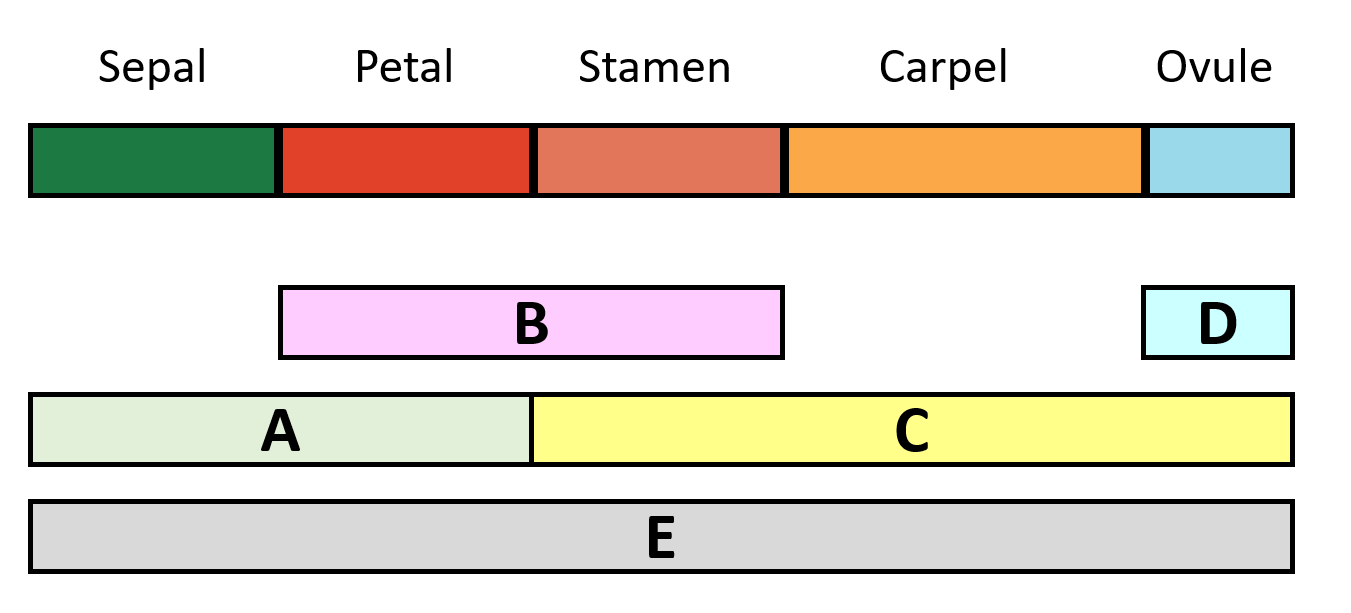
Thus, each whorl results from the expression of a different gene combination as follows:
- Expression of A and E genes produce sepals.
- Expression of A, B, and E genes produce petals.
- Expression of B, C, and E genes produce stamens.
- Expression of C and E genes produce carpels. To produce ovules, which are considered part of the carpels, D genes must also be expressed (C+D+E = ovules).
In summary, the formation of a flower requires a cascade of sequential gene activity that gradually converts a mass of undifferentiated cells (the shoot apical meristem) into the parts of a flower. The genes encode transcription factors that act as master switches, turning on (or off) downstream genes that ultimately make each part of the flower in its appropriate location.
RELATED POSTS
View all

