Learning Objective
Define transpiration and identify how environmental factors affect transpiration rate.
Less than 1% of the water reaching the leaves is used in photosynthesis and plant growth. Most of it is lost in transpiration, the loss of water vapor to the atmosphere through stomata. It is a passive process, meaning that metabolic energy in the form of ATP is not required for water movement. The energy driving transpiration is the difference in water potential between the soil and the atmosphere. Transpiration serve two functions- it provides the force for lifting the water up the stems and it cools the leaves. However, the volume of water lost in transpiration can be very high. It has been estimated that over the growing season, one acre of corn (maize) plants may transpire 400,000 gallons (1.5 million liters) of water. As liquid water, this would cover the field with a lake 15 inches (38 cm) deep.
Transpiration involves several cellular structures in the leaf (Figure ). Water on the surface of mesophyll cells saturates the cellulose microfibrils of the primary cell wall. The leaf contains many large intercellular air spaces for the exchange of oxygen for carbon dioxide, which is required for photosynthesis. The wet cell wall is exposed to this leaf internal air space, and the water on the surface of the cells evaporates into the air spaces, decreasing the thin film on the surface of the mesophyll cells.
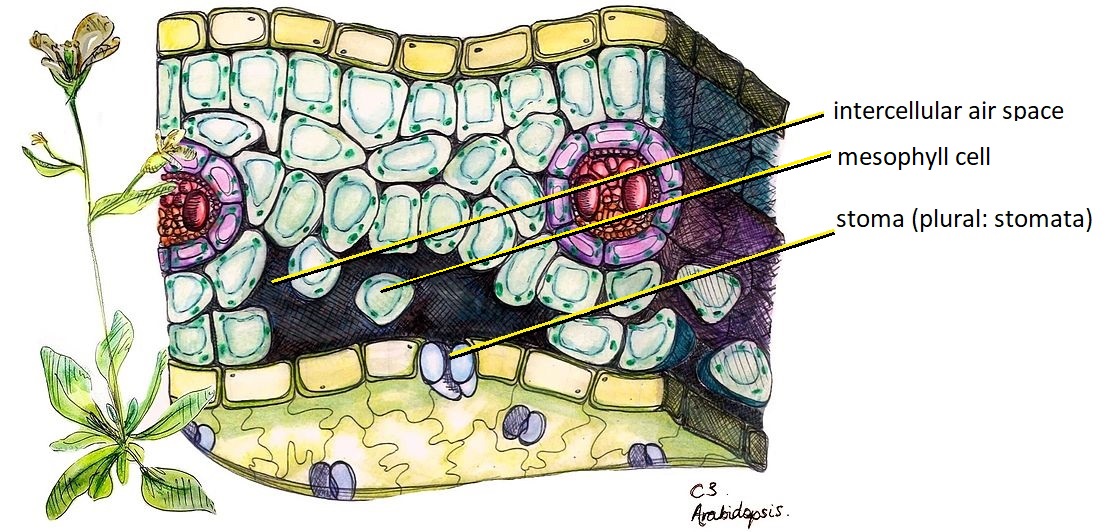
Several environmental factors influence transpiration rate, which can be measured with a potometer (Figure ). Light, high temperatures, and wind increase transpiration rate while humidity reduces it. Light stimulates stomatal opening (see Stomatal Opening and Closure), allowing water vapor to easily leave the leaf. Light also speeds up transpiration by warming the leaf. Plants transpire more rapidly at higher temperatures because water evaporates more rapidly as the temperature rises. At 30°C, a leaf may transpire three times as fast as it does at 20°C. Humidity decreases transpiration rate by reducing the difference in water potential between the air and intercellular air spaces. The rate of diffusion of any substance increases as the difference in concentration of the substances in the two regions increases. When the surrounding air is dry, diffusion of water out of the leaf goes on more rapidly. As transpiration occurs, the air surrounding a leaf becomes increasingly humid, reducing the difference in water potential between the intercellular air spaces and the atmosphere and slowing transpiration. When a breeze is present, however, the humid air is carried away and replaced by drier air. Plants can regulate transpiration through opening and closing stomata, and plants that live in especially hot or dry regions have special adaptations to reduce water loss.

Attributions
Curated and authored by Melissa Ha using the following sources:
- 30.5 Transport of Water and Solutes in Plants from Biology 2e by OpenStax (licensed CC-BY). Access for free at openstax.org.
- 16.2C Transpiration from Biology by John. W. Kimball (licensed CC-BY)
- 4.5.1.2.1: Adaptations to Reduce Transpiration Adaptations to reduce transpiration rate in dry environments include a thick cuticle, trichomes, and succulence. Summer deciduous plants loose their leaves when hot, dry conditions would otherwise cause too much water loss. C4 and CAM photosynthetic pathways also help conserve water while limiting photorespiration.
- 4.5.1.2.2: Stomatal Opening and Closure Stomata are pores in the epidermis of the plant, mostly found in leaves. Blue light triggers stomatal opening, and water stress triggers stomata closure. Whether a stoma is open or closed is determined by the turgor pressure of the two guard cells that surround it.
RELATED POSTS
View all