Learning

open
close

Anthocerotophyta

April 23, 2026 | by Bloom Code Studio

Learning Objectives

  • Use morphological traits and cellular components to distinguish between hornworts and other bryophytes.
  • Identify structures and phases in the hornwort life cycle; know their ploidy.
  • Label a hornwort sporophyte and describe its development.

Hornworts, Phylum Anthocerotophyta

The name Anthocerotophyta means ‘horn flower plant’. These strange plants, called the hornworts, get their name from the horn-like sporophytes they produce. Hornworts have a flattened thalloid gametophyte, out of which grow their long photosynthetic sporophytes (Figure ), composed of a sporangium with a columella and pseudoelaters. The sporophyte grows from a basal meristem, with the oldest tissues at the apex. When spores have matured, the sporangium dries and dehisces, twisting open to release spores. The long, multicellular pseudoelaters (true elaters are a single cell) within the sporangium assist in dispersing the spores. Hornworts are somewhat rare and quite small, and they prefer shady and wet places. They are often found growing on the muddy sides of waterways, from small ditches to larger creeks.

The presence of stomata on sporophytes and the ability of some hornwort sporophytes to branch (and sometimes even live independently from the gametophyte!) lend support for the hypothesis that hornworts are sister to vascular plants (tracheophytes). However, hornworts are discussed first in this chapter due to their strictly thalloid gametophyte morphology.
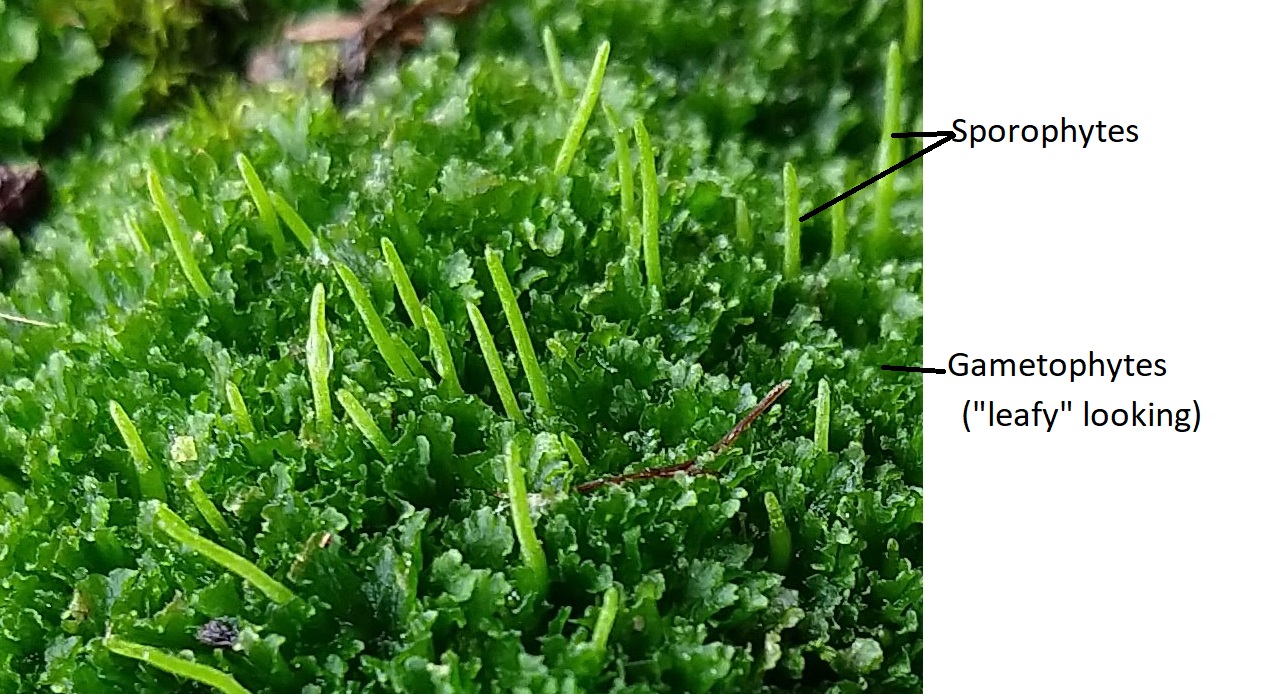
Hornwort showing both sporophyte and gametophyte generations
Figure : Hornworts growing in a cluster. The gametophytes are the leafy green material growing closer to the surface. The sporophytes are the emergent structures. The appearance of the sporophytes is what gives the hornworts their name. Photo by Maria Morrow, CC-BY-NC.

Gametophyte Morphology

Hornwort gametophytes are exclusively thalloid, often with compartments of mutualistic cyanobacteria from the genus Nostoc. Cells within the gametophyte are monoplastidic (Figure ), containing one large chloroplast in each cell. Similar to the green algae, hornwort chloroplasts contain a pyrenoid where starch storage is concentrated. On the exterior of the thallus, simple pores allow for gas exchange. Unlike stomata, simple pores have no guard cells, meaning they are permanently open. Some hornwort species house colonies of Nostoc within the gametophyte thallus, providing access to nitrogen fixed by the cyanobacterial colony.
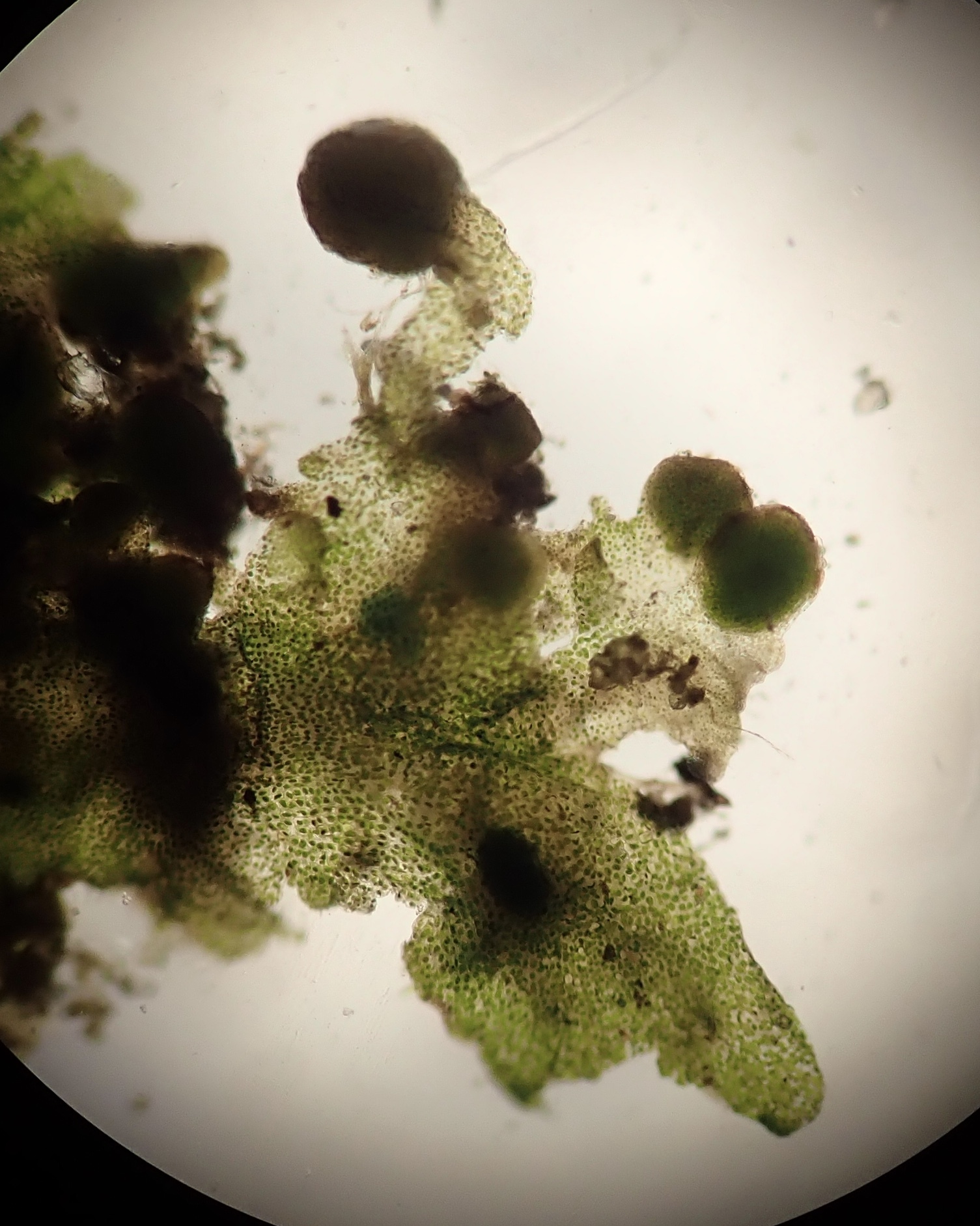
Piece of a thallus viewed under a microscope. The cells of the thallus each have a single, large green plastid, which is the only visible organelle.
Figure : This image of part of a Phaeoceros proskaueri thallus shows the cells of the gametophyte each containing a single large plastid (monoplastidic). The second photo is a cropped view with a single cell encircled. A line indicates the single chloroplast within that cell. Photo by Amanda Heinrichsome rights reserved (CC-BY-NC).

Sporophyte Morphology

Hornwort sporophytes are comprised of a linear sporangium that lacks a seta. It grows from a basal meristem, meaning the cells at the apex are the oldest. When you see the sporangia mature, this becomes more obvious, as the tip dries out first and dehisces (Figure ) to release the spores. Unlike the gametophyte, the sporophyte possesses true stomata for gas exchange, though stomata have been lost in some lineages. Notably, hornwort sporophytes are photosynthetic and capable of transferring photosynthates to the gametophyte. In other bryophyte lineages, the sporophyte is almost entirely dependent on the gametophyte for nutrition.

Within the sporgangium, there is a central columella (Figure ) and often pseudoelaters and/or sterile cells that aid in spore dispersal by twisting when dry.
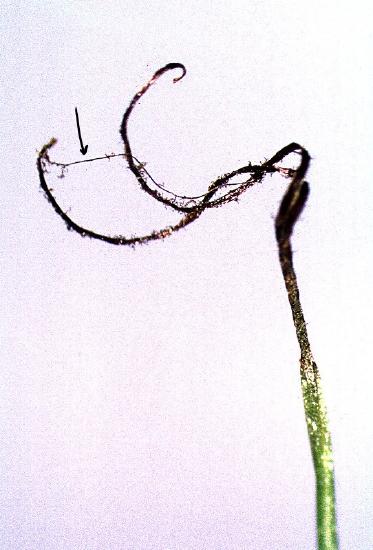
A dehiscing sporophyte.
Figure : The sporophyte of Phaeoceros opens by two “valves”, liberating the spores. Between the valves a structure known as the columella is found (indicated by arrow). It consists of a column of sterile tissue in the center of the spore-forming tissue. In this image, the columella is visible as a very slender, black, wire-like structure between the valves. Photo and caption text by George Shepherd, CC BY-NC-SA with arrow added by Maria Morrow. Descriptive text: The tip of the sporophyte is blackened and has split in two. There is a thin black strand emerging from the center, indicated by an arrow. The base of the sporophyte is still green.
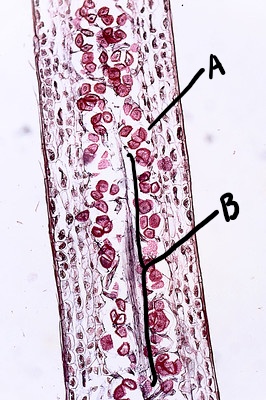
A cross section through a hornwort sporangium. The spores (labeled A) are clustered toward the inside around a central column (labeled B).
Figure : A cross section through an Anthoceros sporophyte. Spore tetrads (A) fill the sporangium and surround the central columella (B). The second photo shows the spore tetrads at a higher magnification. Photos by George Shepherd, CC BY-NC-SA with labels added by Maria Morrow.

Stomata on the sporophyte may assist in spore dispersal by allowing the sporangium to dry, providing conditions necessary for dehiscence. Figure  walks through the stages of sporophyte maturation, showing the appearance of the stomata at each stage.
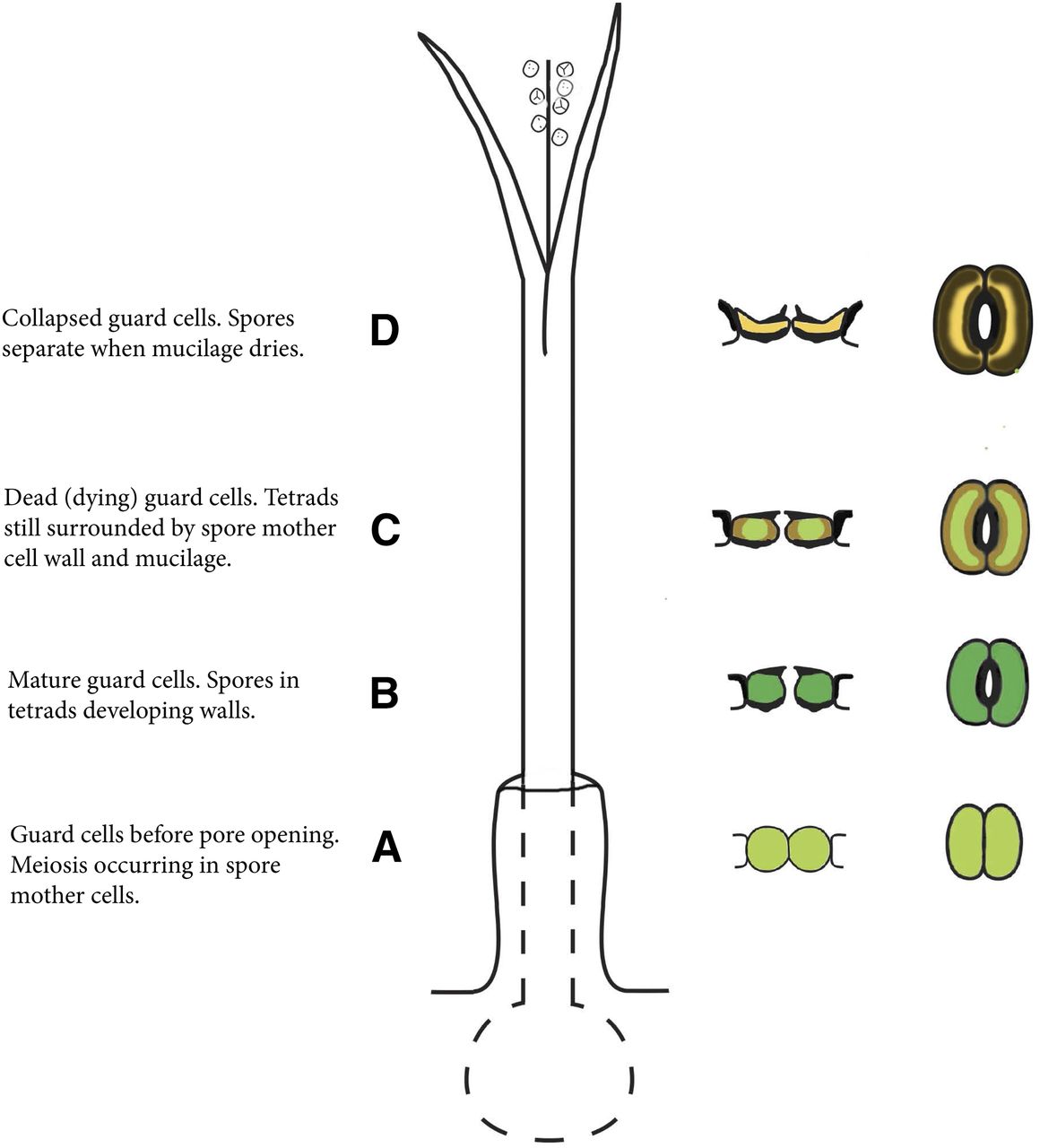
A diagram of sporophyte maturation. Descriptive text: The base is labeled A and says "Guard cells before pore opening. Meiosis occurring in spore mother cells." There are stomata shown to the right at this level that are plump, light green, and closed. Above this region, it is labeled B and says "Mature guard cells. Spores in tetrads." The stomata to the right are a darker green and open. The area above this is labeled C and says "Dead (dying) guard cells. Spore tetrads still surrounded in mother cell wall/mucilage." The stomata to the right are slightly deflated, lighter green and lined with brown. The top of the sporangium, labeled D, has dehisced open and the text says "Collapsed guard cells. Spores separate when mucilage dries." The stomata on the right are yellow lined with dark brown, deflated, and open.
Figure : Diagrammatic representation of a hornwort sporophyte with progressive development and color of stomata indicated from the base upward. Once open, stomata never close, but the outer aperture increases slightly in width after guard cell collapse. The stomata color does not necessarily coincide with the overall color of the sporophyte because stomata die and collapse while the sporophyte is actively photosynthesizing. A, Developing stoma. B, Mature, living, and open stoma. C, Dead (dying) guard cells at the onset of collapse of the outer walls. D, Dead, collapsed, and slightly larger stoma. Above D, the sporophyte dries, leading to dehiscence into two valves along two parallel suture lines, mucilage dries around the spore tetrads, the spore mother cell wall adheres to the spore surfaces, and the spores separate for dispersal. Image and caption text from the open-access paper Hornwort Stomata: Architecture and Fate Shared with 400-Million-Year-Old Fossil Plants without Leaves by Karen S. Renzaglia, Juan Carlos Villarreal, Bryan T. Piatkowski, Jessica R. Lucas, Amelia Merced. Plant Physiology Jun 2017, 174 (2) 788-797.

Life Cycle

The hornwort life cycle, like all plants, is alternation of generations. The multicellular haploid stage, the gametophyte, is the longer-lived and larger phase of this life cycle. Most hornwort gametophytes are monecious, meaning both types of gametangia (antheridia and archegonia) are produced on the same gametophyte. The life cycle shown in Figure  features a monoecious gametophyte. If a hornwort is dioecious, the life cycle would have antheridia and archegonia produced on separate gametophytes and the sporophyte would grow from the gametophyte producing archegonia.

As will be the case with all plants, archegonia produce one or more eggs and antheridia produce many sperm. These haploid gametes are produced by mitosis. The sperm have two flagella and must swim through water to reach the egg at the base of the archegonium. Fertilization (fusion of the egg and sperm) results in a diploid zygote. This zygote grows within the archegonium, nourished by the gametophyte. All land plants retain and nourish the zygote, called an embryo, and so are sometimes referred to as the embryophytes. Meiosis occurs within the sporangium (also called a capsule), producing haploid spores that are dispersed aerially.
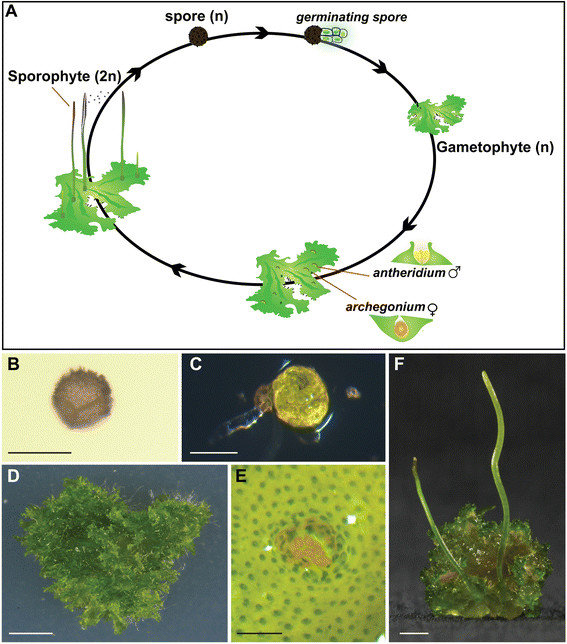
A life cycle diagram for a hornwort
Figure : Life cycle of the hornwort Anthoceros agrestis. The life cycle of A. agrestis (A) starts with the spore (B) that germinates (C) and gives rise to the gametophyte (D). Gametophytes are monoecious and thus individual plants bear both male antheridia (E) and female archegonia. After fertilization of the egg by sperm from the antheridia, the zygote is retained within the archegonium. The resultant embryo develops into the sporophyte (F) in which spores are produced via meiosis. Scale bars = B: 40 μm; C: 100 μm; D: 2 mm; E: 200 μm; F: 2 mm. Caption text and image from Szövényi, Péter & Frangedakis, Eftychios & Ricca, Mariana & Quandt, Dietmar & Wicke, Susann & Langdale, Jane. (2015). Establishment of Anthoceros agrestis as a model species for studying the biology of hornworts. BMC Plant Biology. 15. DOI: 10.1186/s12870-015-0481-x. CC BY 4.0

RELATED POSTS

View all

view all