


A number is rational if we can write it as a fraction, where both denominator and numerator are integers and the denominator is a non-zero number.
The below diagram helps us to understand more about the number sets.
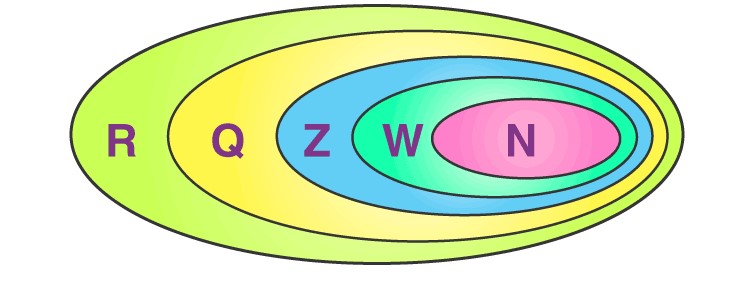
- Real numbers (R) include all the rational numbers (Q).
- Real numbers include the integers (Z).
- Integers involve natural numbers(N).
- Every whole number is a rational number because every whole number can be expressed as a fraction.
Standard Form of Rational Numbers
The standard form of a rational number can be defined if it’s no common factors aside from one between the dividend and divisor and therefore the divisor is positive.
For example, 12/36 is a rational number. But it can be simplified as 1/3; common factors between the divisor and dividend is only one. So we can say that rational number ⅓ is in standard form.
Positive and Negative Rational Numbers
As we know that the rational number is in the form of p/q, where p and q are integers. Also, q should be a non-zero integer. The rational number can be either positive or negative. If the rational number is positive, both p and q are positive integers. If the rational number takes the form -(p/q), then either p or q takes the negative value. It means that
-(p/q) = (-p)/q = p/(-q).
Now, let’s discuss some of the examples of positive and negative rational numbers.
| Positive Rational Numbers | Negative Rational Numbers |
|---|---|
| If both the numerator and denominator are of the same sign. | If the numerator and denominator are of opposite signs. |
| All are greater than 0 | All are less than 0 |
| Examples of positive rational numbers: 12/17, 9/11 and 3/5 | Examples of negative rational numbers: -2/17, 9/-11 and -1/5. |
RELATED POSTS
View all

