Associative as the name implies, means grouping. The origin of the term associative is from the word “associate”. Basic mathematical operations that can be performed using the associate property are addition and multiplication. This is normally applicable to more than 2 numbers.
As in the case of Commutative property, the order of grouping does not matter in Associative property. It will not alter the result. The grouping of numbers can be done in parenthesis irrespective of the order of terms. Thus, the associative law expresses that it doesn’t make a difference which part of the operation is carried out first; the answer will be the same.
Note: Both associative and commutative property is applicable for addition and multiplication only.
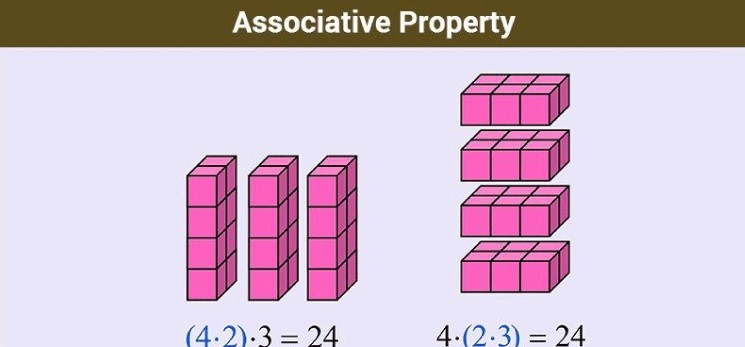
Associative Property for Addition
The addition follows associative property i.e. regardless of how numbers are parenthesized the final sum of the numbers will be the same. Associative property of addition states that:
(x+y)+z = x+(y+z)
Let us say, we want to add 5+10+4. It can be seen that the answer is 19. Now, let us group the numbers; put 5 and 10 in the bracket. We get,
⇒ (5+10)+4 = 15+4 = 19
Now, let’s regroup the terms like 10 and 4 in brackets;
⇒ 5+(10+4) = 5 + 14 = 19
Yes, it can be seen that the sum in both cases are the same. This is the associative property of addition.
Let us see some more examples.
(1) 3+(2+1) = (3+2)+1
3+3 = 5+1
6 = 6
L.H.S = R.H.S
(2) 4+(-6+2) = [4 + (-6)] + 2
4 + (-4) = [4-6] + 2
4-4 = -2+2
0 = 0
L.H.S = R.H.S
RELATED POSTS
View all