

Structure of ATP
May 17, 2024 | by Bloom Code Studio

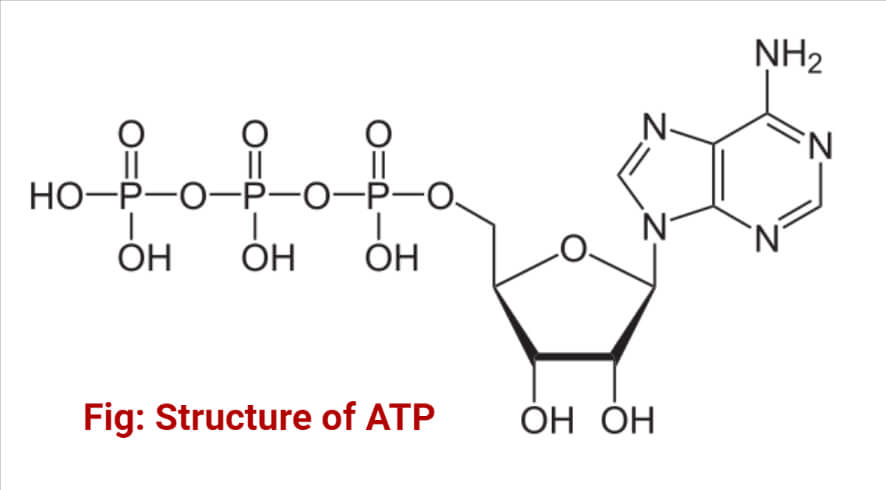
It consists of adenine, ribose, and a triphosphate moiety. Adenosine is attached by the 9-nitrogen atom to the 1-carbon atom of ribose which in turn is attached at the 5-carbon atom of sugar to a triphosphate group. Three phosphate groups form a triphosphate moiety. They are termed alpha (α), beta (β), and gamma (γ) phosphate groups. There are three phosphodiester bonds; one between phosphate groups, the second between the phosphate groups, and the third between the phosphate and ribose sugar. The first two are high-energy phosphodiester linkage and produce energy during hydrolysis. Hence, hydrolysis of ATP to ADP (Adenosine Diphosphate) and again to AMP (Adenosine Monophosphate) yields energy, but the breaking of the phosphodiester bond between ribose and the phosphate requires energy.
RELATED POSTS
View all


Hydrolysis of ATP
May 17, 2024 | by Bloom Code Studio
Functions of ATP
May 17, 2024 | by Bloom Code Studio
Production of ATP
May 17, 2024 | by Bloom Code Studio