


1. Pleural mesothelioma
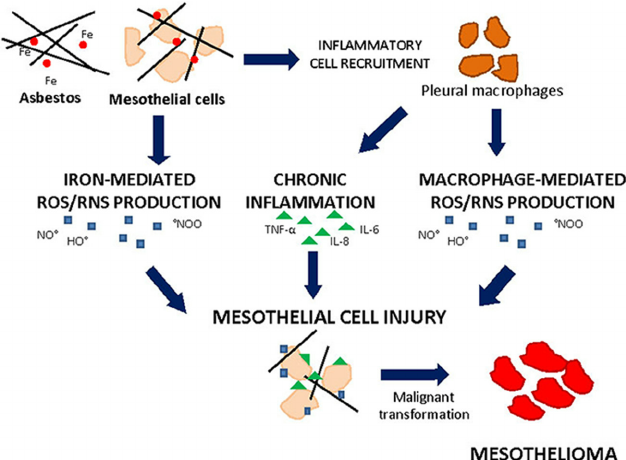
- Once tiny asbestos fibers are inhaled, they are difficult to expel due to their extremely small size and hydrophobicity. They make their way into the inner space of the lungs and slowly into the epithelial cells into the visceral or parietal pleura which are both the layers of mesothelium. The microscopic jagged asbestos is not metabolized or cleared hence, it remains for life. The presence of these fibers leads to an inflammatory response and DNA damage. Eventually mutations may arise that lead to the epithelial cells dividing uncontrollably resulting into tumors.
- Directly, asbestos interferes with the mitosis process in cell division, which can cause cellular damage and mutation. Indirectly, asbestos can cause mesothelial cells to release mutagenic reactive oxygen and nitrogen, which also causes mutation.
2. Peritoneal mesothelioma
- Similarly, asbestos fibers can also end up in the stomach if saliva containing the material or mucous from the airways is swallowed. They, there make their way into the epithelial tissues and produce similar sequence of events.
3. Pericardial mesothelioma
- Asbestos may also travel through the lymph nodes to other parts of the body, such as the pericardium, the mesothelial layer surrounding the heart.
RELATED POSTS
View all

