

Types of Parenchyma Cell
May 13, 2024 | by Bloom Code Studio

Parenchymal cells are classified into 7 types based on function.
- Chlorenchyma:
- Chlorenchyma is usually present in the mesophyll tissue of the leaves.
- It is a parenchymatous cell with chloroplasts.
- Additionally, they are also present in the outer cortex of the stem of the young plant.
- These cells are generally loosely packed with multiple intracellular spaces.
- The stem and the aerial root of the plants are green due to the presence of chlorenchyma cells. It helps in photosynthesis.
- Aerenchyma:
- Aerenchyma is present in aquatic plants, and its function is to provide buoyancy to the plant.
- These cells are loosely packed with plenty of intracellular space as larger air cavities.
- The aerenchyma naturally forms in the root of rice.
- It helps in the diffusion of air from leaves to the roots as it is present continuously from shoots to roots and helps in maintaining sufficient oxygen levels for respiration.
- In case excess oxygen is consumed, it diffuses out from roots to the soil atmosphere and creates an aerobic rhizosphere in anaerobic soil.
- These cells store respiratory gases (oxygen and carbon dioxide), which can be utilized by the plants when required.
- Prosenchyma:
- Prosenchyma cells are present in the vascular tissue of the plant,
- These cells characteristically elongate, and narrow-sized parenchyma possess interpenetrating tapering(pointed) ends.
- Vascular parenchyma:
- Vascular parenchyma provides nutrients to the vascular tissue where it is present.
- Some parenchymal cells store ergastic substances (resins, tannins). Example: axial and ray parenchyma, which are present in wood, form tylose in the heartwood. Tylose blocks the xylem cavity, thereby preventing water transportation through them.
Vascular parenchyma is of two types.
a. Phloem parenchyma:
- It contains cylindrical, elongate, and tapering cells with dense cytoplasm.
- In monocotyledons, phloem parenchyma is absent.
- It stores food and other material such as resins, mucilage, and latex.
b. Xylene parenchyma:
- Its cell wall is thin and made up of cellulose.
- In water stress conditions, it prevents vessels and tracheids from being damaged.
- Radial transportation of minerals and water takes place via ray parenchymatous cells.
- Medullary parenchyma:
- The medullary parenchyma is present in the medullary ray of primary vascular tissue.
- These cells are radially elongated with very thin-walled cells.
- These cells allow radial distribution of water and mineral to the plant
- It helps in the storage of starch grains.
- Conjunctive parenchyma:
- Conjunctive parenchyma makes the conjunctive tissue of the stele of roots.
- In monocots, conjunctive tissue becomes sclerenchyma when mature.
- It is present in the root system made tubular outgrowth called root hair. It helps to absorb minerals and water from the soil.
- Armed parenchyma:
- These cells are present in the mesophyll part of gymnosperm, and they lokes like star-shaped.
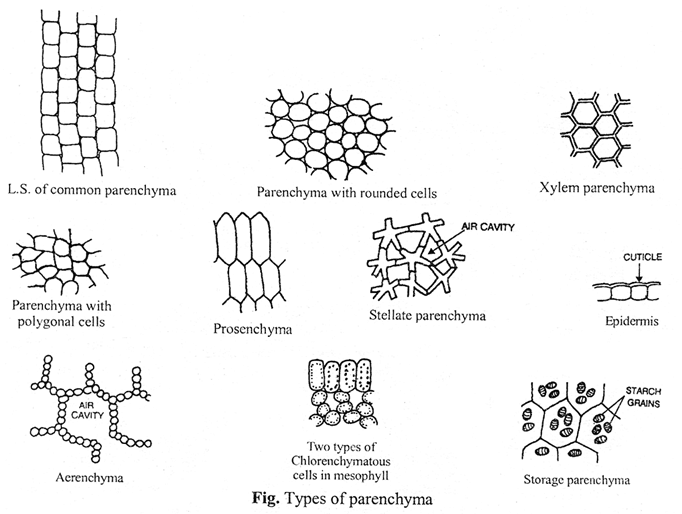
On the basis of shape, Parenchyma cells are classified into two types:-
- Angular parenchyma:
- Its shape is polygonal with angular ends.
- That is completely packed without intracellular space.
- Circular parenchyma:
- These cells are structurally circular in outline.
- These are loosely packed with more intracellular space.
RELATED POSTS
View all


What are Parenchyma Cells?
May 13, 2024 | by Bloom Code Studio
Functions of Parenchyma Cell
May 13, 2024 | by Bloom Code Studio
Structure of Parenchyma Cell
May 13, 2024 | by Bloom Code Studio