

Trophic Cascade Theory and Apex Predators
May 13, 2024 | by Bloom Code Studio

There have been several attempts to come up with a proper definition for the term trophic cascade and its theory. Still, it refers to ‘the interaction of different intermediary species via an indirect manner, spreading downward in a top-down forcing through food web that originated with predators.’ This definition confers the ‘consumptive effects’ of trophic cascades, or the predators would have starved, leading to extensive population growth as preys have no predation risk. Thus the emphasis of trophic cascades beginning with higher trophic level species and spreads downward to fulfill the necessary balance of energy flow in the ecosystem.
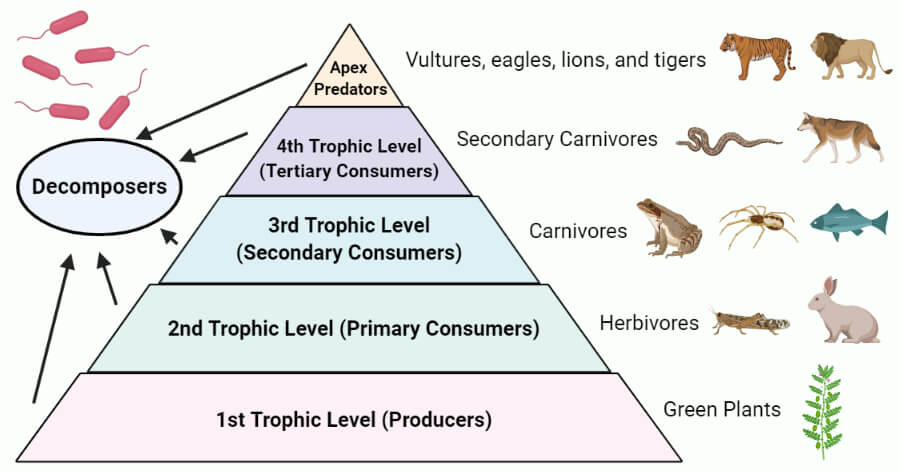
Consider the example of the top-down forcing trophic cascade of grey wolves’ impact on herbivore ‘elk’ (Cervus elaphus), to significantly influence berry-producing shrubs consumed by the grizzly bears (Ursus arctos). This depicts the trophic cascade event that started with the apex predator, the grey wolf, and its influence through the food web, affecting the prey dynamics and plant species in that locality. Remarks by Darwin, ‘t the presence of a feline animal in large numbers in a district might determine, through the intervention first of mice and then of bees, the frequency of certain flowers in that district.
Ecological Effect of Trophic Cascade
- Due to globalization, we see a shift in the species introduction and distribution into a new area which led to alarming concern among the biologist and conservation managers regarding the decrease and extinction of native species.
- The repatriation of apex predators shifts and influences the non-native ecologies and enhances the coexistence of native-non-native contexts.
- Thus, we can conclude that trophic cascades regulate the species’ population and composition and biomass distribution and influence the growth of herbivores and plant species in the terrestrial and aquatic environments.
Demerits of Native-Non-native Dichotomy
- There seems to be more concern among conservationists that the control efforts of introducing new species to an area do not promise to restore native communities or limit non-native species because controlled efforts require more interventions.
- For instance, eradicating ‘Felis catus’ (non-native cats) from the offshore islands of New Zealand and Australia led to the intrusion of non-native rats (Rattus exulans) and rabbits (Oryctolagus cuniculus) that harm the native flora and bird populations.
- Though it is believed that introducing non-native species has a beneficial ecological effect and enhanced biodiversity, they even substitute for the ecological aid deficit due to the extinct native population.
- And the role of Apex Predators as biodiversity environmental drivers has a huge influence on the native-non-native dichotomy.
RELATED POSTS
View all


Conclusion
May 13, 2024 | by Bloom Code Studio
Keystone Species as Apex Predators
May 13, 2024 | by Bloom Code Studio
Apex Predators- Definition, Trophic Cascade, Examples
May 13, 2024 | by Bloom Code Studio