

Life Cycle of Gymnosperms
May 13, 2024 | by Bloom Code Studio

The life cycle of gymnosperms follows alternation of generation, which means plants alternate between sporophyte (spore-bearing phase) and gametophyte (gamete-bearing phase) generation.
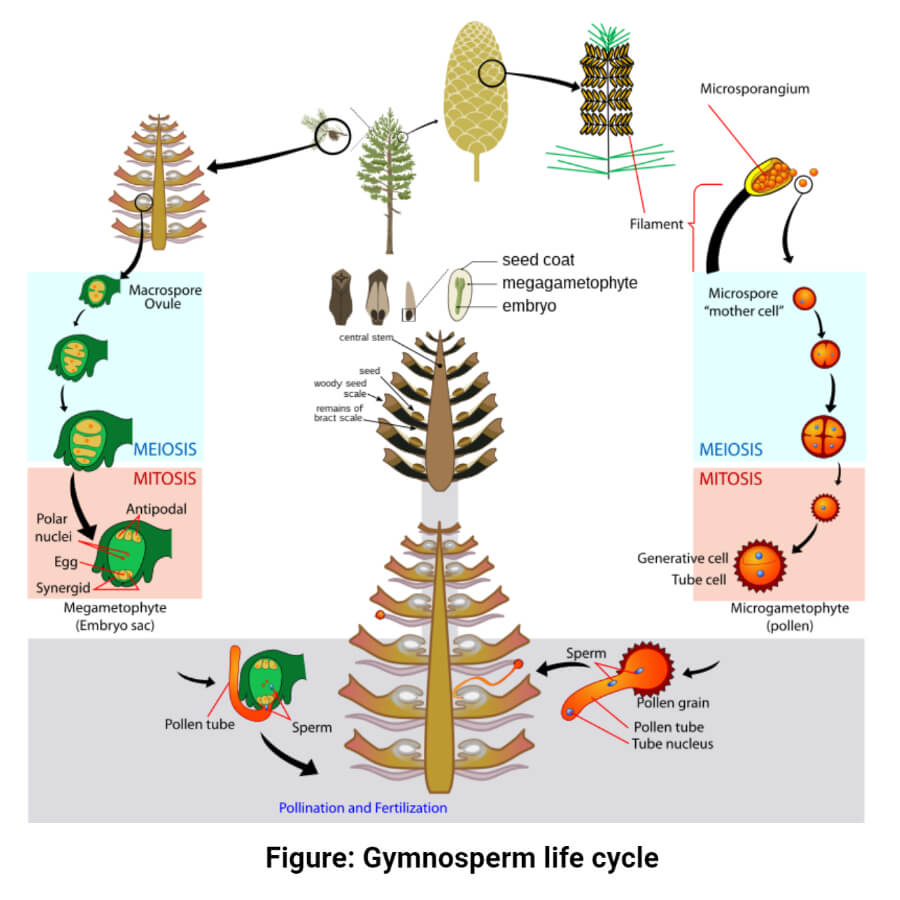
In a gametophyte phase, gametes are produced by sexual reproduction, and in a sporophyte phase, spores are produced by asexual reproduction.
Sporophyte generation
- The sporophyte generation represents adult (including roots, stems, cones, and leaves), diploid (contain two sets of chromosomes), and photosynthetic plants that produce the male and female cones.
- Cones developed either in the same plant or in different plants. In the case of male and female cones present in the same plant, the female cones or strobili are produced in the upper part of the branches, and male cones are present in the lower portion.
- Male strobili of gymnosperms produced haploid microspores, and female cones produced megaspores by the process of meiosis.
Gametophyte generation
- After microspore and megaspores undergo meiosis, haploid microgametophyte (male gamete) and haloid female gametophyte (megagametophyte) are produced.
- These gametophytes have a short life span and are developed into sperm cells by male gametophytes and egg cells by female gametophytes.
- Gametophytes take a nutrient from sporophyte, and the female gamete remains attached to it until they undergo the fertilization process and seeds disperse.
- Male and female gamete unite at pollination to produce a zygote (diploid). Pollination occurs due to winds, natural agents, animals, or insects.
- New diploid sporophytes produce when zygote mature.
- The newly formed sporophyte is enclosed in a seed (in the form of an embryo), seeds are separated and dispersed via wind and rain when favorable conditions are reached.
- Seeds are spreading to different places, saprophyte germinate and develop into a new adult, diploid plant and again begin the same process.
RELATED POSTS
View all


Classification of Gymnosperms
May 13, 2024 | by Bloom Code Studio
Morphology and Anatomy of Gymnosperms
May 13, 2024 | by Bloom Code Studio
Examples of Gymnosperms
May 13, 2024 | by Bloom Code Studio