


Bond Length
During chemical bonding, when the atoms come closer to each other, the attraction takes place between them, and the potential energy of the system keeps on decreasing till a particular distance at which the potential energy is minimum. If the atoms come closer, repulsion starts, and again, the potential energy of the system begins to increase.
At equilibrium distance, the atoms keep on vibrating about their mean position. The equilibrium distance between the centres of the nuclei of the two bonded atoms is called its bond length.
It is expressed in terms of an angstrom (A0) or picometer (pm). It is determined experimentally by x-ray diffraction or electron diffraction method, or spectroscopic method. The bond length in chemical bonding is the sum of the ionic radii in an ionic compound. In a covalent compound, it is the sum of its covalent radii. For a covalent molecule AB, the bond length is given by d = ra + rb
Factors Affecting the Bond Length
- Size of the atoms: The bond length increases with an increase in the size of the atom. HI > HBr > HCl > HF
- The multiplicity of bond: The bond length decreases with an increase in bond order.
- Type of hybridization: A‘s’ orbital is smaller in size; the greater the ‘s’ character, the shorter the bond length.
Bond Enthalpy
When atoms come close together, energy is released due to the chemical bonding between them. The amount of energy required to break one mole of bonds of a type so as to separate the molecule into individual gaseous atoms is called bond dissociation enthalpy or bond enthalpy. Bond enthalpy is usually expressed in KJ mol-1.
The greater the bond dissociation enthalpy, the greater the bond strength. For diatomic molecules, like H2, Cl2, O2, N2, HCl, HBr and HI, the bond enthalpies are equal to their dissociation enthalpy.
In the case of polyatomic molecules, bond enthalpies are usually the average values because the dissociation energy varies with each type of bond.
In H20, first O-H bond enthalpy = 502 KJ/mol; Second bond enthalpy = 427 KJ/mol Average bond enthalpy = (502 + 427) / 2 = 464.5 KJ/mol
Factors Affecting Bond Enthalpy in Chemical Bonding
Size of the Atom
The greater the size of the atom, the greater the bond length, and the less the bond dissociation enthalpy, i.e., less the bond strength during chemical bonding.
Multiplicity of Bonds
The greater the multiplicity of the bond, the greater the bond dissociation enthalpy.
Number of Lone Pair of Electrons Present
The more the number of lone pairs of electrons present on the bonded atoms, the greater the repulsion between the atoms, and thus, less is the bond dissociation enthalpy of the chemical bond.
Bond Angle
A bond is formed by the overlap of atomic orbitals. The direction of overlap gives the direction of the bond. The angle between the lines representing the direction of the bond, i.e., the orbitals containing the bonding electrons, is called the bond angle.
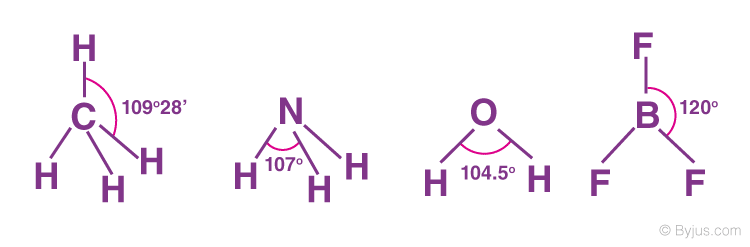
Factors Affecting Bond Enthalpy in Chemical Bonding
Bond Order
In Lewis representation, the number of bonds present between two atoms is called the bond order. The greater the bond order, the greater the stability of the bond during chemical bonding, i.e., the greater the bond enthalpy. The greater the bond order, the shorter the bond length.
RELATED POSTS
View all

