


Did you know that stars die! When stars run out of hydrogen, the nuclear fusion reactions at their core stop and become unstable and collapse. It is important to note that not all stars collapse the same way. Massive stars explode into a supernova and then collapse into neutron stars, or black holes. We know this because of the work of astrophysicist Subrahmanyan Chandrasekhar. Chandrasekhar was an Indian-born scientist who spent 50 years at the University of Chicago. He is most famous for coming up with the theory that explains the death of the universe’s most massive stars. Before Chandrasekhar, scientists assumed that all stars collapsed into white dwarfs when they died. Chandrasekhar limit is the famous prediction done by Subrahmanyan Chandrasekhar.
What is Chandrasekhar Limit?
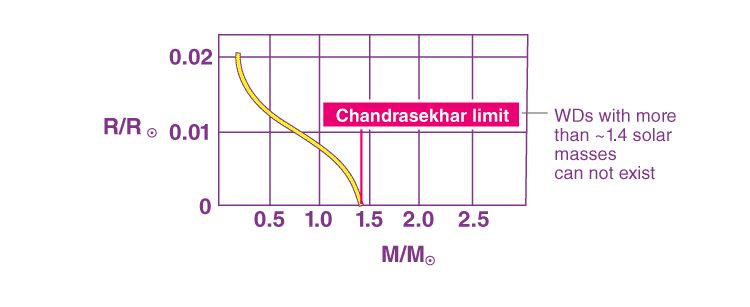
The utmost mass that a white dwarf star that’s stable can have is known as the Chandrasekhar limit. E.C. Stoner and Willhelm Anderson pointed it out in their papers and termed it after Subrahmanyan Chandrasekhar, an Indian astrophysicist who made major independent discoveries on improving the preciseness of computation.
The scientific community ignored the limit at the start as it would legitimize the existence of black holes (technically unrealistic at this turn-off time). Due to the pressure of electron degeneration, the white dwarf stars oppose its gravitational collapse.
Chandrasekhar limit is established at a point when the mass at which the pressure from the degeneration of electrons is not able to balance the self-attraction of the gravitational field. The limit that has been established these days is 1.39 M☉.
You may also want to check out these concepts related to Stars!
- Stars And Celestial Objects
- Constellations And Constellation Of Stars
- Difference Between Stars and Planets
Explanation:
Pauli’s exclusion principle gives rise to a phenomenon of quantum mechanics termed as Electron degeneracy pressure. Electrons cannot have the same state or the minimum-energy level. This is because they are fermions.
A spectrum of energy levels exists, and electrons should be distributed throughout them. When the electron gas is compressed, the amount of electrons in a specific volume increases, and so does the energy level of the band that has been occupied. Thus, to produce the electron degeneracy pressure, pressure must be applied for the compression of the electron gas as their energy increases when compressed. Electron capture occurs when that pressure is so great that the electron goes into the nuclei.
RELATED POSTS
View all

