


Lines And Angles are the basic shapes in geometry. Lines are figures that are made up of infinite points extending indefinitely in both directions. Lines are straight and have negligible depth or width. There are a variety of lines you will learn about, such as perpendicular lines, intersecting lines, transversal lines, etc. An angle is a figure in which two rays emerge from a common point. You may also come across alternate and corresponding angles in this field. Geometry shapes and their properties are the most practical branch of mathematics. Mostly this concept has been taught in Class 7 and Class 9.
Definition of Lines and Angles
As we have discussed, both lines and angles form the base for any shape in geometry. We cannot draw a two-dimensional to three-dimensional shape without using lines and angles. Thus, it is very necessary to learn the definitions of both terms.
Here, the basic definitions and properties of lines and also for angles are given. It will give the students a basic knowledge of these geometrical terms.
What are Lines?
A line is a straight one-dimensional figure, that extends in the opposite directions infinitely. A line can be horizontal or vertical. It can be drawn from left to right or top to bottom.
What are Angles?
Angles are the shape that is formed when the endpoints of two rays meet at a single point. They are measured in degrees (°) or radians. A complete rotation is equal to an angle of 360 degrees. It is represented by the symbol ‘∠’.
Types of Lines and Angles
There are various types of lines and angles in geometry based on the measurements and different scenarios. Let us learn here all those lines and angles along with their definitions.
Types of Lines
Lines are basically categorized as:
- Line segment
- Ray
Based on concepts or operations performed on lines, they are;
- Parallel Lines
- Perpendicular Lines
- Transversal
Line Segment
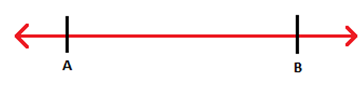
A line segment is a part of a line with two end-points. It is the shortest distance between two points and has a fixed length.
Ray
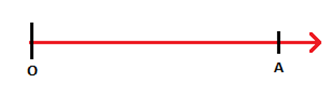
A ray is a part of a line, which has a starting point and extends infinitely in one direction.
Perpendicular Lines
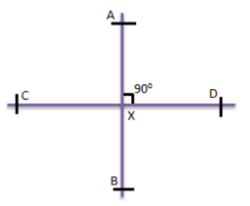
When two lines form a right angle with each other, by meeting at a single point, are called perpendicular lines. In the figure, you can see, lines AB and CD are perpendicular to each other.
Parallel Lines
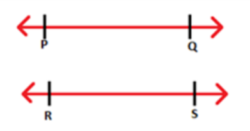
Two lines are said to be parallel when they do not meet at any point in a plane or which do not intersects each other. In the figure, lines PQ and RS are parallel to each other.
Transversal Line
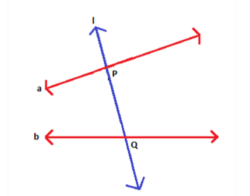
When a line intersects two lines at distinct points, it is called a transversal. In the figure, a transversal l is intersecting two lines at point P and Q.
Types of Angles
Angles are basically classified as:
- Acute Angle(<90°)
- Right Angle(=90°)
- Obtuse Angle(>90°)
- Straight Angle(=180°)
And based on the relation between two angles, conceptual wise, they are;
- Supplementary Angles
- Complementary Angles
- Adjacent Angles
- Vertically Opposite Angles
Acute Angle
If the inclination between the arms is less than a right angle, it is called an acute angle.
Obtuse Angle
If the inclination between the arms is more than a right angle, it is called an obtuse angle.
Right Angle
If the arms form an angle of 90 degrees between them, it is called a right angle.
Straight Angle
If the arms form an angle of 180 degrees between them, it is called a straight angle.
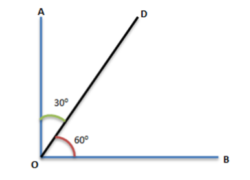
Complementary Angles
Two angles which sum up to 90 degrees are called complementary angles.
Supplementary Angles
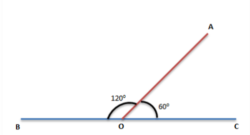
Two angles which sum up to 180 degrees are called supplementary angles.
Adjacent Angles
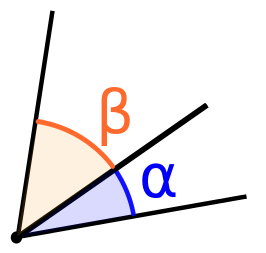
Two angles which have a common side and a common vertex are called adjacent angles. In the following figure, ∠α and ∠β are adjacent angles.
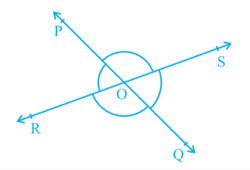
Vertically Opposite Angles
Two angles which are formed, opposite to each other, when two lines intersect at a common point or vertex, are called vertically opposite angles. In the figure, given below;
∠POR = ∠SOQ and ∠POS = ∠ROQ
RELATED POSTS
View all

