


Heron’s formula is used to find the area of a triangle when we know the length of all its sides. It is also termed as Hero’s Formula. We can apply Heron’s formula to find different types of triangles, such as scalene, isosceles and equilateral triangles. We don’t have to need to know the angle measurement of a triangle to calculate its area, by using Heron’s formula.
What is Heron’s Formula?
Heron’s formula is a formula to calculate the area of triangles, given the three sides of the triangle. This formula is also used to find the area of the quadrilateral, by dividing the quadrilateral into two triangles, along its diagonal.
History of Heron’s Formula
Hero of Alexandria was a great mathematician who derived the formula for the calculation of the area of a triangle using the length of all three sides. He also extended this idea to find the area of quadrilateral and also higher-order polygons. This formula has its huge applications in trigonometry such as proving the law of cosines or the law of cotangents, etc.
Heron’s Formula for Triangles
According to Heron, we can find the area of any given triangle, whether it is a scalene, isosceles or equilateral, by using the formula, provided the sides of the triangle.
Suppose, a triangle ABC, whose sides are a, b and c, respectivel.
Where “s” is semi-perimeter = (a+b+c) / 2
And a, b, c are the three sides of the triangle.
Proof of Heron’s Formula
There are two methods by which we can derive Heron’s formula.
- First, by using trigonometric identities and cosine rule.
- Secondly, solving algebraic expressions using the Pythagoras theorem.
Let us see one by one both the proofs or derivation.
Using Cosine Rule
Let us prove the result using the law of cosines:
Let a, b, c be the sides of the triangle and α, β, γ are opposite angles to the sides.
How to Find the Area Using Heron’s Formula?
To find the area of a triangle using Heron’s formula, we have to follow two steps:
- Find the perimeter of the given triangle
- Then, find the value of the semi-perimeter of the given triangle; s = (a + b + c)/2
- Now use Heron’s formula to find the area of a triangle (√(s(s – a)(s – b)(s – c)))
- Finally, represent the area with the accurate square units (such as m2, cm2, in2, etc.)
Heron’s Formula for Equilateral Triangle
As we know the equilateral triangle has all its sides equal. To find the area of the equilateral triangle let us first find the semi perimeter of the equilateral triangle will be:
s = (a + a + a)/2
s = 3a/2
where a is the length of the side.
Heron’s Formula for Scalene Triangle
As we know, a scalene triangle has all three unequal sides, thus, we can directly use the original Heron’s formula to find the area.
Area of scalene triangle = √s(s – a)(s – b)(s – c),
where s = (a + b + c)/2
Heron’s Formula For Quadrilateral
Let us learn how to find the area of quadrilateral using Heron’s formula here.
If ABCD is a quadrilateral, where AB||CD and AC & BD are the diagonals.
AC divides the quad.ABCD into two triangles ADC and ABC.
Now we have two triangles here.
Area of quad.ABCD = Area of ∆ADC + Area of ∆ABC
So, if we know the lengths of all sides of a quadrilateral and the length of diagonal AC, then we can use Heron’s formula to find the total area.
Hence, we will first find the area of ∆ADC and area of ∆ABC using Heron’s formula and at last, will add them to get the final value.
Applications of Heron’s Formula
The two major applications of Heron’s formula are:
- To find the area of different types of a triangle (when the length of three sides are given)
- To find the area of a quadrilateral (when the length of all three sides are given)
Solved Examples
Let us now look into some examples to have a brief insight into the topic:
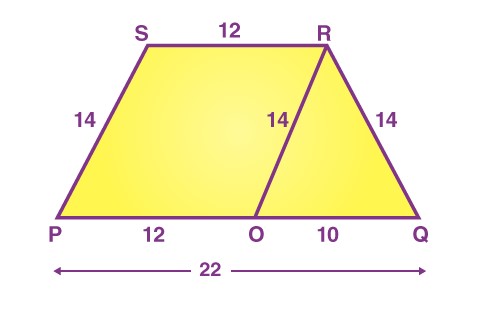
Example 1: Find the area of a trapezium, the length of whose parallel sides is given as 22 cm and 12 cm and the length of other sides is 14 cm each.
Solution: Let PQRS be the given trapezium in which PQ = 22 cm, SR = 12 cm,
PS = QR = 14 cm.
Constructions: Draw OR||PS
Now, PORS is a parallelogram in which PS||OR and PO||SR
Therefore, PO = SR = 12 cm
⇒ OQ = PQ – PO = 22 – 12 = 10 cm
RELATED POSTS
View all

