

Difference Between AC and DC Generator
July 9, 2023 | by Bloom Code Studio

The difference between AC and DC generators is one of the most discussed topics among physics enthusiasts. In this article, the main differences between AC and DC generators are given in a simple and easy-to-understand way in tabular form. These AC and DC generator differences can help students learn about this topic better and remember the points more effectively.
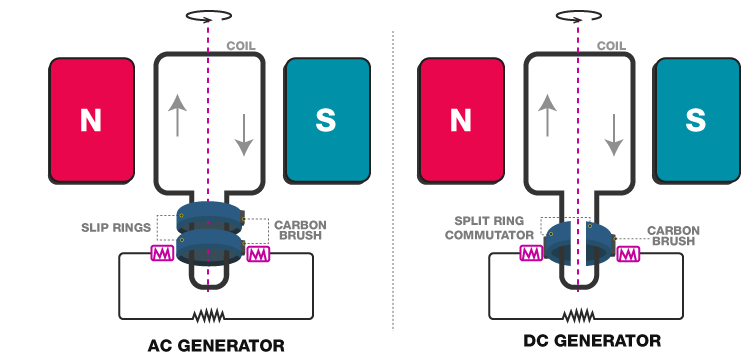
Before going to the differences, it is important to learn about AC generators and DC generators in detail. By knowing their details, understanding the differences becomes easy and simple.
What is an AC Generator?
An AC generator is an electric generator that converts mechanical energy into electrical energy in the form of alternative emf or alternating current. An AC generator works on the principle of “Electromagnetic Induction”.
What is a DC Generator?
A DC generator is a machine that converts mechanical energy into DC (direct current) electricity. The energy alteration process uses the principle of energetically induced electromotive force.
What are the differences between AC and DC Generator?
| Sl. No. | Differentiating Property | AC Generator | DC Generator |
|---|---|---|---|
| 1 | Definition | AC generator is a mechanical device that converts mechanical energy into AC electrical power. | DC generator is a mechanical device that converts mechanical energy into DC electrical power. |
| 2 | Direction of Current | In an AC generator, the electrical current reverses direction periodically. | In a DC generator, the electrical current flows only in one direction. |
| 3 | Basic Design | In an AC generator, the coil through which the current flows is fixed while the magnet moves. The construction is simple and costs are less. | In a DC generator, the coil through which the current flows rotate in a fixed field. The overall design is very simple but construction is complex due to commutators and slip rings. |
| 4 | Commutators | AC generator does not have commutators. | DC generators have commutators to make the current flow in one direction only. |
| 5 | Rings | AC generators have slip-rings. | DC generators have commutators. |
| 6 | Efficiency of Brushes | Since slip-rings have a smooth and uninterrupted surface, they do not wear quickly and are highly efficient. | Both brushes and commutators of a DC generator wear out quickly and thus are less efficient. |
| 7 | Short Circuit Possibility | As the brushes have high efficiency, a short circuit is very unlikely. | Since the brushes and commutators wear out quickly, sparking and short circuit possibility is high. |
| 8 | Rotating Parts | The rotating part in an AC Generator is a low current high resistivity rotor. | The rotating part in a DC generator is generally heavy. |
| 9 | Current Induction | In an AC generator, the output current can be either induced in the stator or in the rotor. | In a DC generator, the output current can only be induced in the rotor. |
| 10 | Output Voltage | AC generators produce a high voltage which varies in amplitude and time. The output frequency varies (mostly 50Hz to 60Hz). | DC generators produce a low voltage when compared to AC generator which is constant in amplitude and time i.e. output frequency is zero. |
| 11 | Maintenance | AC generators require very little maintenance and are highly reliable. | DC generators require frequent maintenance and are less reliable. |
| 12 | Types | AC generators can be of varying types like 3 phase generators, single-phase generators, synchronous generator, induction generator, etc. | DC generators are mainly two types which are Separately excited DC generator and self-excited DC generator. According to field and armature connection, they can be further classified as DC series, shunt, or compound generators, respectively. |
| 13 | Cost | The initial cost of an AC generator is high. | The initial cost of a DC generator is less when compared to AC generators. |
| 14 | Distribution and Transmission | The output from AC generators is easy to distribute using a transformer. | The output from DC generators is difficult to distribute as transformers cannot be used. |
| 15 | Efficiency | AC generators are very efficient as the energy losses are less. | DC generators are less efficient due to sparking and other losses like copper, eddy current, mechanical, and hysteresis losses. |
| 16 | Applications | It is used to power smaller motors and electrical appliances at homes (mixers, vacuum cleaners, etc.) | DC generators power very large electric motors like those needed for subway systems. |
These were the main AC and DC generator differences. In the above difference between DC and AC generators, several higher-level concepts are also included to give in-depth insights about them. This is extremely important for the students wishing to pursue engineering (especially electrical).
Apart from these differences, students can also check additional related articles given below. The additional related articles can help to learn similar topics in a better and more effective way. Click the links given below for more related articles.
RELATED POSTS
View all


Difference between Alternator and Generator
July 9, 2023 | by Bloom Code Studio
Difference between Concave and Convex Mirror
July 9, 2023 | by Bloom Code Studio