


Maxwell was the first person to calculate the speed of propagation of electromagnetic waves, which was the same as the speed of light and came to the conclusion that EM waves and visible light are similar.
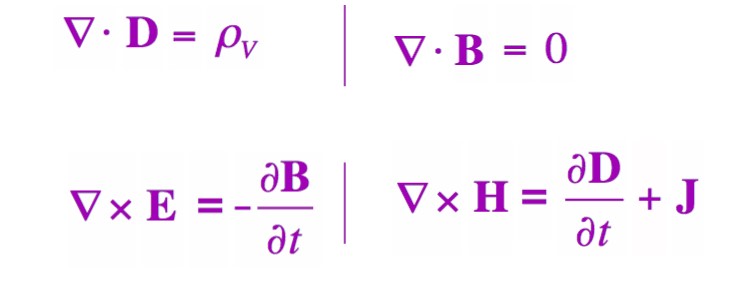
These are the set of partial differential equations that form the foundation of classical electrodynamics, electric circuits and classical optics along with Lorentz force law. These fields highlight modern communication and electrical technologies.
Maxwell’s equations integral form explain how the electric charges and electric currents produce magnetic and electric fields. The equations describe how the electric field can create a magnetic field and vice versa.
Maxwell First Equation
Maxwell’s first equation is based on the Gauss law of electrostatic, which states that “when a closed surface integral of electric flux density is always equal to charge enclosed over that surface”
Mathematically Gauss law can be expressed as,
Over a closed surface, the product of the electric flux density vector and surface integral is equal to the charge enclosed.
Maxwell Second Equation
Maxwell second equation is based on Gauss law on magnetostatics.
Gauss law on magnetostatics states that “closed surface integral of magnetic flux density is always equal to total scalar magnetic flux enclosed within that surface of any shape or size lying in any medium.”
Mathematically it is expressed as –∯∯�→.��=���������—–(1)
| Scalar Electric Flux (𝜓) | Scalar Magnetic Flux (𝜙) |
| They are the imaginary lines of force radiating in an outward direction | They are the circular magnetic field generated around a current-carrying conductor. |
| A charge can be source or sink | No source/sink |
Maxwell Third Equation
Statement: Time-varying magnetic field will always produce an electric field.
Maxwell’s 3rd equation is derived from Faraday’s laws of Electromagnetic Induction. It states that “Whenever there are n-turns of conducting coil in a closed path placed in a time-varying magnetic field, an alternating electromotive force gets induced in each coil.” Lenz’s law gives this. Which states, ” An induced electromotive force always opposes the time-varying magnetic flux.”
When two coils with N number of turns, A primary coil and a Secondary coil. The primary coil is connected to an alternating current source, and the secondary coil is connected in a closed loop and is placed at a small distance from the primary coil. When an AC current passes through the primary coil, an alternating electromotive force gets induced in the secondary coil.
Maxwell’s Fourth Equation
It is based on Ampere’s circuit law. To understand Maxwell’s fourth equation, it is crucial to understand Ampere’s circuit law,
Consider a wire of a current-carrying conductor with the current I. Since there is an electric field, there has to be a magnetic field vector around it. Ampere’s circuit law states that “The closed line integral of magnetic field vector is always equal to the total amount of scalar electric field enclosed within the path of any shape”, which means the current flowing along the wire(which is a scalar quantity) is equal to the magnetic field vector (which is a vector quantity).
- Gauss Law
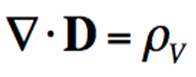
Gauss law describes the nature of the electric field around electric charges. The law is expressed in terms of electric charge density and electric charge density. The inverted triangle is called the divergence operator.
The equations hold good at any point in space. When the electric charge exists any somewhere, the divergence of D at that particular point is nonzero, else it is zero.
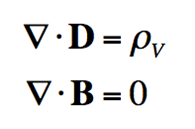
You need to be familiar with Gauss Law for the electric field to understand this equation. You can see that both the equations indicate the divergence of the field. The top equation states that the divergence of the electric flux density D equals the volume of electric charge density.
The second equation states the divergence of the Magnetic Flux Density (B) is null.
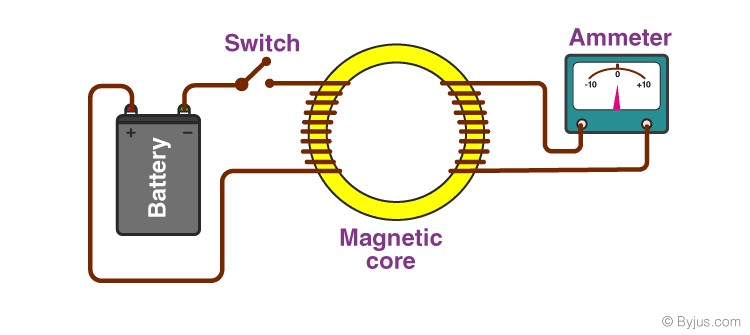
Faraday was a scientist whose experiment setup led to Faraday’s Law which is shown in the figure below.
The experiment is not very complex. When a battery is disconnected, no electricity flows through the wire. Hence, no magnetic flux is induced in the iron (Magnetic Core). The iron acts like a magnetic field that flows easily in a magnetic material. The purpose of the core is to form a path for the flow of magnetic flux.
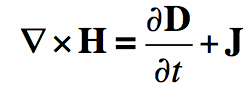
The law shows the relationship between the flow of electric current and the magnetic field around it. Suppose the wire carries a current I, the current produces a magnetic field that surrounds the wire.
RELATED POSTS
View all

