We have studied various concepts of optics in our previous sessions. We have come across various laws like snell’s law, laws of reflection, and many more. In this article, let us learn about Lambert’s cosine law and luminous flux derivation.
Lambert’s Cosine Law Explanation
Lambert’s cosine law states that the radiant intensity from the ideal diffusely reflecting surface and cosine of the angle θ between the direction of incident light and surface normal are directly proportional. This law is named after Johann Heinrich Lambert which is studied in optics and is also known as Lambert’s emission law or cosine emission law.
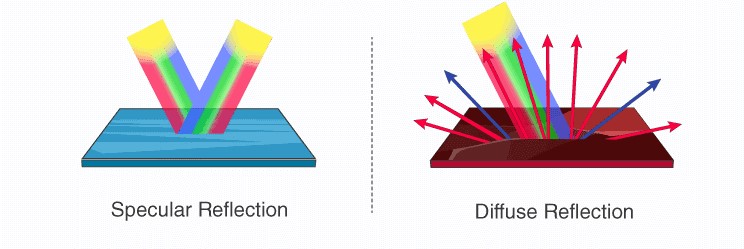
Diffuse Reflection
Diffuse reflection can be defined as the type of reflection of light or an incident ray where scattering happens at many angles and not just at one angle. Lambertian reflectance is the property exhibited by diffusely reflecting surface.
Lambertian reflectance is defined as that property of substances due to which they appear equally bright when from any angle.
This is the main difference between specular reflection and diffuse reflection.
Read more: Difference between specular reflection and diffuse reflection
Examples of Diffuse Reflection
- Paints: The matte paints that are used in home painting exhibit diffuse reflection while the glossy paints reflect diffusely along with specular reflection.
- Frosted glass bulb
- Human eye: The primary mechanism of the human eye is to reflect the incident ray in angles which is based on diffuse reflection.
RELATED POSTS
View all