


What is Hubble’s Law?
Hubble’s law statement is given as
The velocity of the galaxy, which is also known as the redshift, is directly proportional to its distance.
Hubble’s law is also known as Hubble-Lemaitre law, studied in physical cosmology. Only with the help of Hubble’s law the universe can expand and fulfil the cosmological principle.
Hubble’s Law Formula
Where,
- v is the velocity of the galaxy in km/s.
- H0 is the Hubble constant in km/s/Mpc.
- d is the distance of the galaxy in Mpc.
- A megaparsec is a unit of measurement equal to one million parsecs or 3.26 million light years.
- Mpc is a common expression for megaparsec.
Limitations of Hubble’s Law
By determining the shift in observed light into redshift in the spectrum, one can determine the distance of the galaxy from us using Hubble’s equation after measuring the recession velocity. The following are the limits of Hubble’s law that make measuring difficult:
- Because of the intrinsic motion of galaxies, observed velocity gets influenced.
- Galaxy orbiting due to gravitational movements.
What is Hubble Constant?
Hubble constant is defined as the unit of measurement, which is used for describing the expansion of the universe. Hubble’s constant H is 160 km/s per million-light-years.
What is Redshift?
Redshift is the phenomenon in which an object’s wavelength increases due to electromagnetic radiation. Blueshift is opposite to redshift, where the energy increases due to shorter wavelengths, which are also known as negative redshift. The main reasons for redshift are as follows:
- Doppler effect ie; the movement of objects either closer or apart from each other in space.
- Strong gravitational force leads to gravitational redshift.
- Cosmological redshift is an expansion of space such that objects are separated without any change in their position.
Interpretation of Redshift And Distance
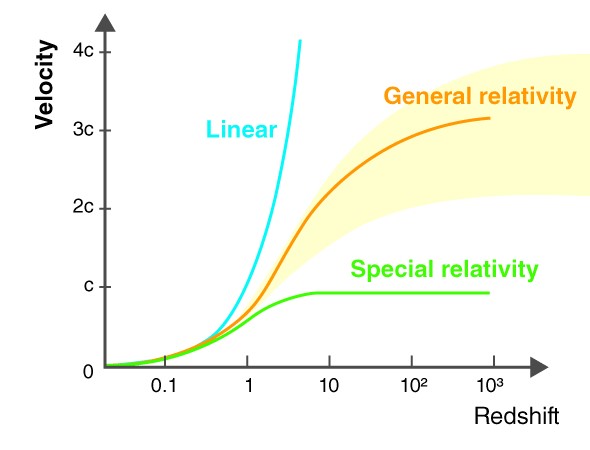
Above is the linear relationship between the redshift and distance and the mathematical expression for Hubble’s law as follows:
v = HοD
Where,
- v is the recessional velocity in km/s
- Hο is is Hubble’s constant.
- D is the proper distance between the galaxy and the observer.
Where,
- z is the redshift.
- Δλ is the shift in wavelength in the spectra.
- λ is the wavelength.
Example of Hubble’s Law
Q1. For some clusters, velocity is measured as v = 103 km/s. What is the distance? Assume Hο = 60km/s/Mpc
Ans: We know,
v = 103 km/s
H0 = 60 km/s/Mpc
The formula used is:
d = v/Hο
=(103 km/s)/(60 km/s/Mpc)
=16.7 Mpc
Units Derived From Hubble Constant
There are three units that are derived from Hubble constant, and they are:Hubble Time
The Hubble time is defined as the age taken by the universe to expand if the expansion was linear and in a different real age. This is dependent on the dimensionless factor, which is dependent on the mass and energy of the content in the universe.
Hubble time is given as follows:
tH = 1/Hο = 1/67.8 (km/s)/Mpc = 4.55.1017s = 14.4 billion years.Hubble Length
The Hubble length is defined as the product of the speed of light and the Hubble time. It is also known as the Hubble distance. The product obtained is equivalent to 14.4 billion light-years. cH0-1 is the Hubble length.Hubble Volume
The Hubble volume is defined as the volume of the observable universe. It is also defined as the volume of sphere whose radius is cH0-1 or a square with side cH0-1.
RELATED POSTS
View all

