In science, we usually talk about two types of research: pure and applied. Pure research focuses on answering basic questions such as, “how do gases behave?” Applied research would be involved in the process of developing specific preparation for a gas in order for it to be produced and delivered efficiently and economically. This division sounds like it would be easy to make, but sometimes we cannot draw a clear line between what is “pure” and what is “applied”.
Examples of “Pure” Research
A lot of “pure” research is of the “what is this?” or “how does it work?” variety. The early history of chemistry contains many examples. The ancient Greek philosophers debated the composition of matter (earth? air? fire? water? all of the above?). They did not intend to apply the knowledge gained from exploring the matter. Instead, they choose to focus on understanding the nature of matter.

Figure 1.3.11.3.1: Ancient Greek philosophers.”A Greek Philosopher and His Disciples”, Antonio Zucchi
Applied Research (Technology)
There is a great deal of “applied” research taking place today. In general, no new science principles are discovered, but existing knowledge is used to develop a new product. A good example of this type of research is the application of x-rays in medicine. In the later part of the 1800s, Wilhelm Röentgen discovered how to produce x-rays by using a cathode ray. He noted that this new ray could go through the body. Immediately, Röentgen believed that x-rays would be very helpful in diagnosing and determining disease and injury in the body.
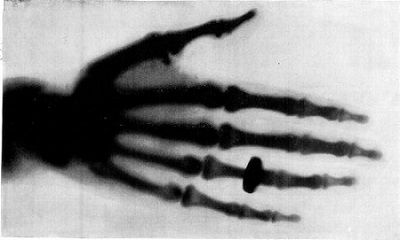
Figure 1.3.21.3.2: Röentgen is the father of the X-ray. while working with experiments and procedures of previous scientists, Röentgen noticed that even through secured chambers for light, an unknown energy was emitted that reacted with phosphorescent materials he was using in his experiments. his discovery and subsequent papers earned him the Nobel Prize in Physics in 1901. He used his wife’s hand to determine if the new rays could pass through the body.
The Conversion of Basic Research to Applied Research
Scientists and engineers desire to understand how the universe works. Many times, this leads to unimaginable applications for their works. During the early 20th century, physicists and engineers performed experiments probing atoms with electricity and/or magnets. This research led to the identification of the three subatomic particles of the atom- electron, proton, and neutron. After determining these particles, physical chemists and physicists began experimenting on the central core of atoms (called nuclei). By bombarding a nucleus with other particles (beta, alpha, or neutron), they were able to transform one element into another.
Artificial transmutation can only occur in the nuclear lab. Large pieces of equipment are needed to change the nucleus. This discovery of altering the nucleus led to the production of new isotopes (atoms of the same element that differ in mass and neutron count). These new isotopes now are used in nuclear medicine (diagnosing and treating disease), nuclear weapons (producing fuel for bombs), sanitizing food, spices, and cosmetics, and nuclear energy.
Undergraduate Research at Furman University
All chemistry majors at our university are required to participate in undergraduate research. During the summertime, many of these students remain on campus to work in our laboratories. Students will join a group and research in one of the following areas: organic, inorganic, analytical, biochemistry, or physical chemistry. Some continue on their research in the calendar year. Upon graduation, all of our majors could enter industry immediately. Others will continue their chemical education by enrolling in Ph.D. programs. Lastly, many of our majors will continue on to become educators, patent attorneys, medical doctors, pharmacists, or physical therapists.
RELATED POSTS
View all