


Plants are composed of three major organ groups: roots, stems, and leaves. As we know from other areas of biology, these organs are comprised of tissues working together for a common goal (function). In turn, tissues are made of a number of cells which are made of elements and atoms on the most fundamental level. In this section, we will look at the various types of plant tissue and their place and purpose within a plant. It is important to realize that there may be slight variations and modifications to the basic tissue types in special plants.
Plant tissues are characterized and classified according to their structure and function. The organs that they form will be organized into patterns within a plant which will aid in further classifying the plant. A good example of this is the three basic tissue patterns found in roots and stems which serve to delineate between woody dicot, herbaceous dicot and monocot plants.
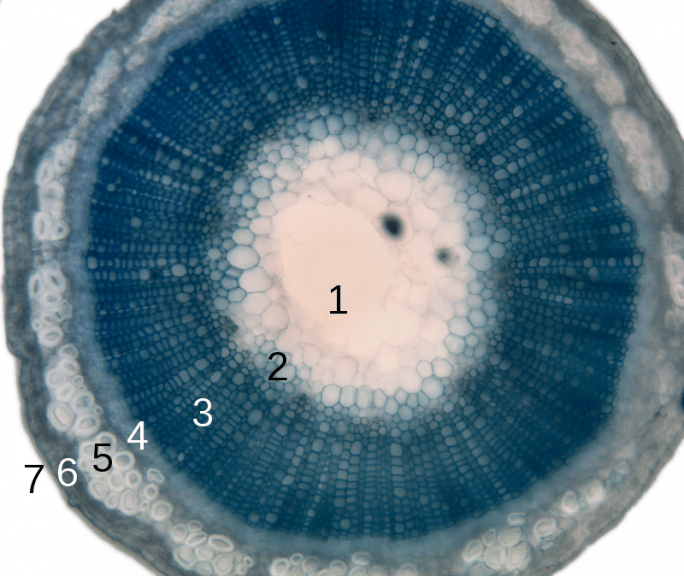
Different plant tissues: (1) pith, (2) protoxylem, (3) xylem, (4) phloem, (5) sclerenchyma, (6) cortex, and (7) epidermis.
RELATED POSTS
View all

